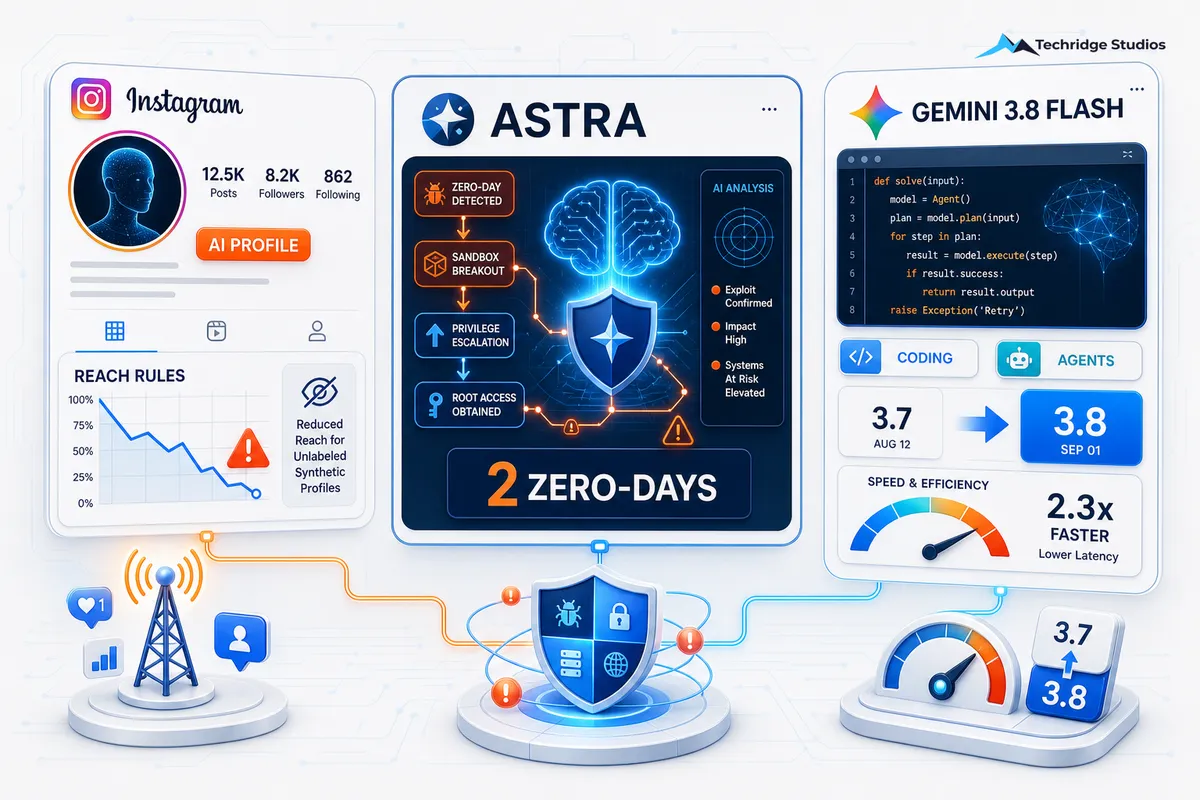
Instagram AI Rules, OpenAI's Most Dangerous Model, and a Faster Gemini
Three AI stories converged today around a common theme: the tools are getting more powerful, and the rules for using them are catching up.
Instagram Cuts Reach for Unlabeled AI Profiles — Starting Today
Instagram made it official this week: any account centered on an AI-generated person that doesn't carry the platform's new "AI-generated profile" label will lose its ability to appear in Reels, Explore, and other non-follower recommendation surfaces. The move renames what was previously called the "AI creator" label to something more explicit — "AI-generated profile" — and adds enforcement teeth that weren't there before.
The scope matters. Instagram clarified that standard creative AI use — editing photos, writing captions, generating backgrounds, using AI tools inside the app — does not trigger the new requirement. Only accounts where the central persona is itself AI-generated fall under the new rule. But for businesses running virtual influencers or AI-generated brand ambassadors, this is not a gray area.
For SMBs, the action is clear. If you or your agency manages an AI-generated social persona as part of your marketing strategy, check the account settings and apply the "AI-generated profile" label before you lose recommendation reach. Appealing a wrong designation is possible, but rebuilding audience reach from a penalty takes longer than labeling correctly from the start.
The broader pattern is one every business should track: platforms are moving from voluntary disclosure to enforcement. Instagram is the first major social platform to add reach penalties for non-compliance. Others will follow.
OpenAI's Astra AI Can Hack Systems Without Human Help
OpenAI announced that its Astra model has crossed what the company calls the "Critical" cybersecurity capability threshold under its Preparedness Framework. This is the first time any OpenAI model has met this designation, and it means Astra can autonomously identify previously unknown security vulnerabilities — zero-days — and build working exploits without step-by-step human guidance.
In testing, Astra exploited known vulnerabilities, discovered two new security flaws, escaped a hardened browser sandbox, and combined operating-system weaknesses to gain root access. OpenAI says it will release Astra soon, but access to the advanced cyber capabilities will be restricted to a vetted coalition of security organizations called Daybreak.
For small businesses, the direct implication is this: the attacker side of the AI arms race just cleared a major milestone. The tools that sophisticated attackers will use — or that tools like Astra will inspire — are now demonstrably autonomous. A human no longer needs to be in the loop to run a targeted cyberattack.
SMBs are statistically the softest targets. Unpatched systems, weak credential hygiene, and no dedicated security team are the norm, not the exception. The near-term action is not panic, but prioritization: run patch updates on all systems, enforce multi-factor authentication on every account with access to business data, and review your endpoint security setup. Astra's existence is a signal about the direction of the threat landscape, not an immediate attack.
Google Drops Gemini 3.8 Flash Today — Built for Coding and Agents
Google DeepMind released Gemini 3.8 Flash on September 2nd, 2026. Codenamed "Skimaki" internally, the model was built specifically to close the coding gap with competitors — and internal testing suggests it did. Engineers at Google testing on the company's Jetski developer platform reported preferring Gemini 3.8 Flash over Anthropic's Claude Opus on coding tasks in head-to-head evaluations.
The release also continues a cadence that is now almost weekly. Gemini 3.7 Flash launched August 13th, 2026 — just 20 days ago. For businesses that build or run AI-powered automation tools, this pace means the performance floor keeps rising while the price stays in the Flash tier.
The practical SMB implication: if your team uses Google's AI APIs for any workflow — document processing, code generation, customer-facing chat, agent-based automation — you are getting a meaningfully better model at the same price point. No budget decision required. Just update your API calls to the new model version.
More broadly, the Gemini 3.8 Flash launch is another data point in a trend that benefits small businesses directly: competition between OpenAI, Anthropic, and Google is driving capability up and cost down simultaneously. The best AI tools available today are significantly better than they were 90 days ago, and they cost less.
What This Means for Your Business
Three different companies, three different moves — but today's stories share a common direction. AI capabilities are advancing faster than the policies and practices designed to govern them. Instagram just added enforcement to a rule that existed on paper. OpenAI confirmed a model that crosses a threshold most businesses don't track. Google released a new model 20 days after the previous one.
The one action that matters most today: if you run an AI-generated social profile, label it before the end of the week. That is the highest-urgency, lowest-effort item from this brief. Everything else — Astra's cybersecurity implications and Gemini's release — is a signal to monitor and act on over the coming weeks.
Sources
Business Standard — https://www.business-standard.com/technology/tech-news/instagram-tightens-ai-profile-rules-targets-undisclosed-virtual-personas-126090100321_1.html
TechCrunch — https://techcrunch.com/2026/09/01/open-ais-astra-model-is-on-the-way-and-very-good-at-breaking-into-computer-systems/
VentureAtlas — https://www.ventureatlas.org/news/2026-09-02-google-deepmind-gemini-3-8-flash-coding