Your Phone, Your Budget, Your Compliance: Three AI Decisions That Hit Today
Apple confirmed what was expected, Microsoft locked in what was fluid, and a legal deadline crept to 22 days. On June 8th, 2026, three of the most concrete AI developments of the year landed at once — and each one has a direct implication for how small and mid-sized businesses operate.
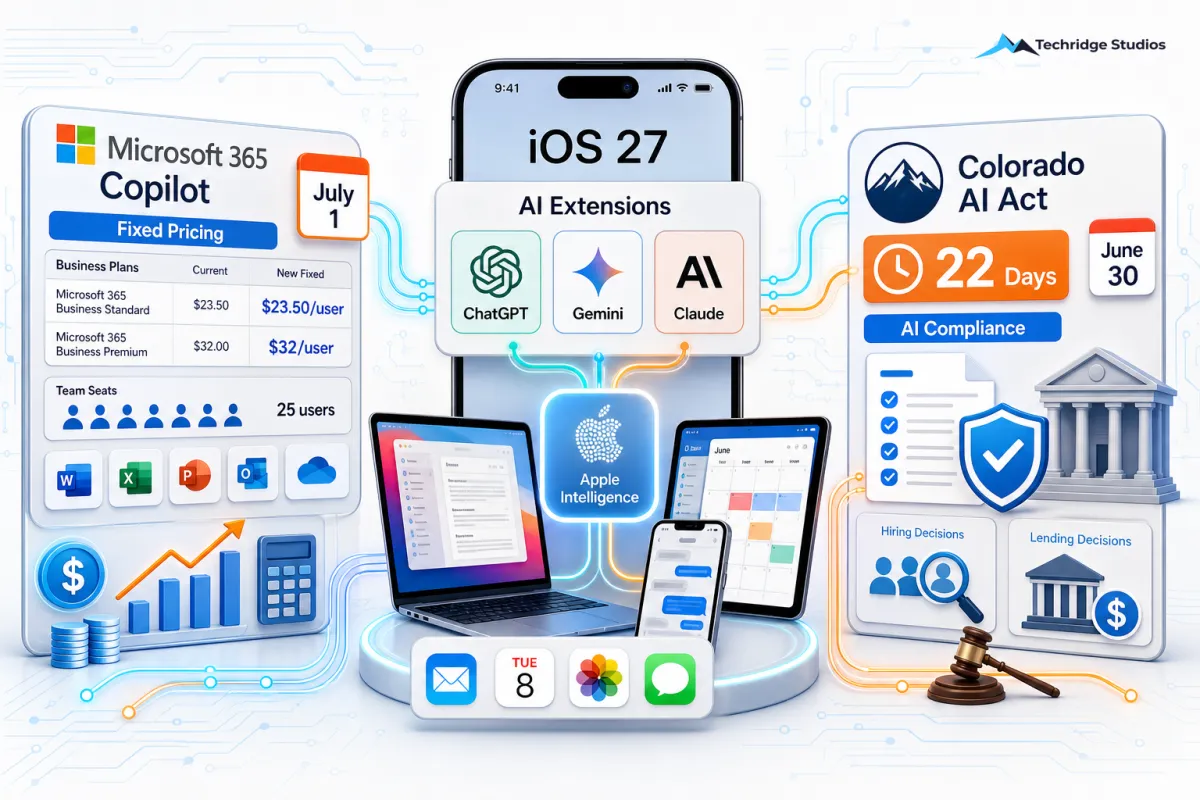
iOS 27 AI Extensions: Every iPhone User Gets to Pick Their AI Model
This morning, Tim Cook delivered his final WWDC keynote as Apple CEO from Apple Park. After two years of delayed Siri promises, Apple showed up with a complete rebuild — and the most consequential detail was not the new voice interface or the Dynamic Island integration. It was a single feature buried in the iOS 27 overview: AI Extensions.
iOS 27 AI Extensions allow users to choose which AI model powers their Apple Intelligence features: Google Gemini (the default, running on a custom 1.2-trillion-parameter model licensed from Google for approximately one billion dollars per year), OpenAI's ChatGPT, or Anthropic's Claude. Each model has a distinct voice, so users know which AI responded. The selection is made in Settings.
For small business owners, this is significant because it ends a forced pairing. Until now, using AI on your iPhone meant using whatever Apple provided. Starting this fall — when iOS 27 ships publicly — a business owner who pays for Claude through Anthropic's API or has built workflows around ChatGPT will be able to run the same AI through Apple Intelligence on their iPhone 15 Pro or newer.
The practical implications run deeper than convenience. Businesses that have standardized on a single AI model for email drafting, document review, or customer communication will be able to carry that choice into their mobile environment. Apple Intelligence requires iPhone 15 Pro or newer at launch. iPhone 11 has been dropped from iOS 27 support entirely. If your team still runs older hardware, the AI model choice feature is not yet relevant — but it signals the direction.
What to do today: Check which iPhones your team uses. If you are on iPhone 15 Pro or newer, iOS 27 Beta 1 is now available to Apple Developer Program members. Plan for your team's AI model preference to be part of your technology onboarding process starting this fall.
Microsoft 365 Copilot Gets a Permanent Price Tag for Small Businesses
One of the most common reasons SMBs have delayed committing to Microsoft AI tools is pricing ambiguity. Microsoft has been offering Copilot-bundled M365 plans, but they carried an implicit uncertainty: these are pilot prices, not permanent ones.
That ambiguity ends July 1st, 2026. Starting that date, Microsoft 365 Business Standard with Copilot becomes a permanent SKU at $23.50 per user per month. Microsoft 365 Business Premium with Copilot becomes a permanent SKU at $32 per user per month. Both are listed as always-on products in the Microsoft Partner Center.
What does that mean in practice? If you have a team of 10 people and you add Microsoft 365 Business Standard with Copilot, you are looking at $235 per month — a number you can include as a line item and budget for. Previously, the implicit risk was that Microsoft could change the offer structure. That risk is now substantially reduced.
Microsoft Copilot in Business Standard gives your team AI-powered drafting, summarization, and search across Word, Excel, Outlook, and Teams. It also includes Copilot in Excel Agent Mode, which can write and explain formulas, clean data, and generate analysis narratives. For small teams who live in Microsoft 365, the productivity value is real — Forrester has estimated AI-enhanced productivity at $7,800 per knowledge worker per year at full utilization, though real-world SMB usage typically lands lower in year one.
What to do today: If you have been evaluating whether to add Microsoft Copilot, July 1st is the clearest moment to make that decision. The price is confirmed. Compare it against what your team currently spends in time on tasks Copilot handles well — drafting, summarizing, and searching across documents.
Colorado AI Act: 22 Days to the First U.S. AI Enforcement Deadline
On June 30th, 2026 — 22 days from today — the Colorado Consumer Protections for Artificial Intelligence Act takes effect. This is not another regulation on paper. It is the first comprehensive U.S. AI law with real enforcement mechanisms, and it covers ground that most small businesses have not fully mapped.
The law applies to developers and deployers of high-risk AI systems. High-risk means AI used to make or substantially influence consequential decisions in six domains: employment (hiring, performance evaluation, termination), healthcare, financial services (lending, insurance eligibility), education, housing, and legal services. If your business uses an AI tool that generates a score, ranking, or recommendation in any of these areas, you may be in scope.
What the law requires: a risk management program for any high-risk AI system, annual impact assessments, disclosure to users when AI is making or influencing a consequential decision, and the right for affected individuals to appeal AI-driven outcomes.
The grace period matters: companies with under $25 million in annual revenue are granted a grace period, delaying enforcement for smaller operators. But the documentation requirements — understanding what AI tools you use, what they do, and what data they touch — still apply and remain best practice regardless of your revenue size.
A federal preemption bill is in play. The Great American Artificial Intelligence Act, introduced in Congress on June 4th, 2026, proposes freezing state AI laws, such as Colorado's, for 3 years. But that bill has not cleared the committee. As of today, the June 30th deadline stands. Companies that have been waiting for federal preemption before taking action on compliance are now 22 days away from a real enforcement date.
What to do today: List every AI tool your business uses. For each one, identify whether it touches any of the six high-risk domains. If it does, document what it does, who reviews its outputs, and whether users are informed. This audit takes less than a day for most small businesses and protects you regardless of how federal legislation is resolved.
What This Means for Your Business
June 8th brought three types of AI pressure at once: a new platform choice (iOS 27), a new cost clarity (Microsoft Copilot pricing), and a new legal reality (Colorado AI Act deadline). Together, they signal that the era of keeping AI at arm's length is closing.
The one action to take this week: if you have not yet mapped which AI tools your business uses and what decisions they touch, do that now. It will inform your iOS 27 model preference, your Microsoft budget, and your compliance posture — all at once.
Sources
Build Fast with AI (Apple WWDC 2026, Colorado AI Act) — https://www.buildfastwithai.com/blogs/ai-news-today-june-8-2026
Microsoft Partner Center / Microsoft Learn — https://learn.microsoft.com/en-us/partner-center/announcements/2026-june
Build Fast with AI (Colorado AI Act enforcement timeline) — https://www.buildfastwithai.com/blogs/ai-news-today-june-8-2026