Your AI Agents Have a New Security Flaw. Here's What Else Moved in AI This Labor Day.
Three stories worth reading before the work week starts — a live credential-theft risk hiding in how most AI tools connect to your apps, federal data that reframes the AI-and-jobs debate, and a new AI feature designed specifically for businesses that cannot afford to put sensitive client data in the cloud.
The MCP Security Risk Your Business Probably Has Not Patched
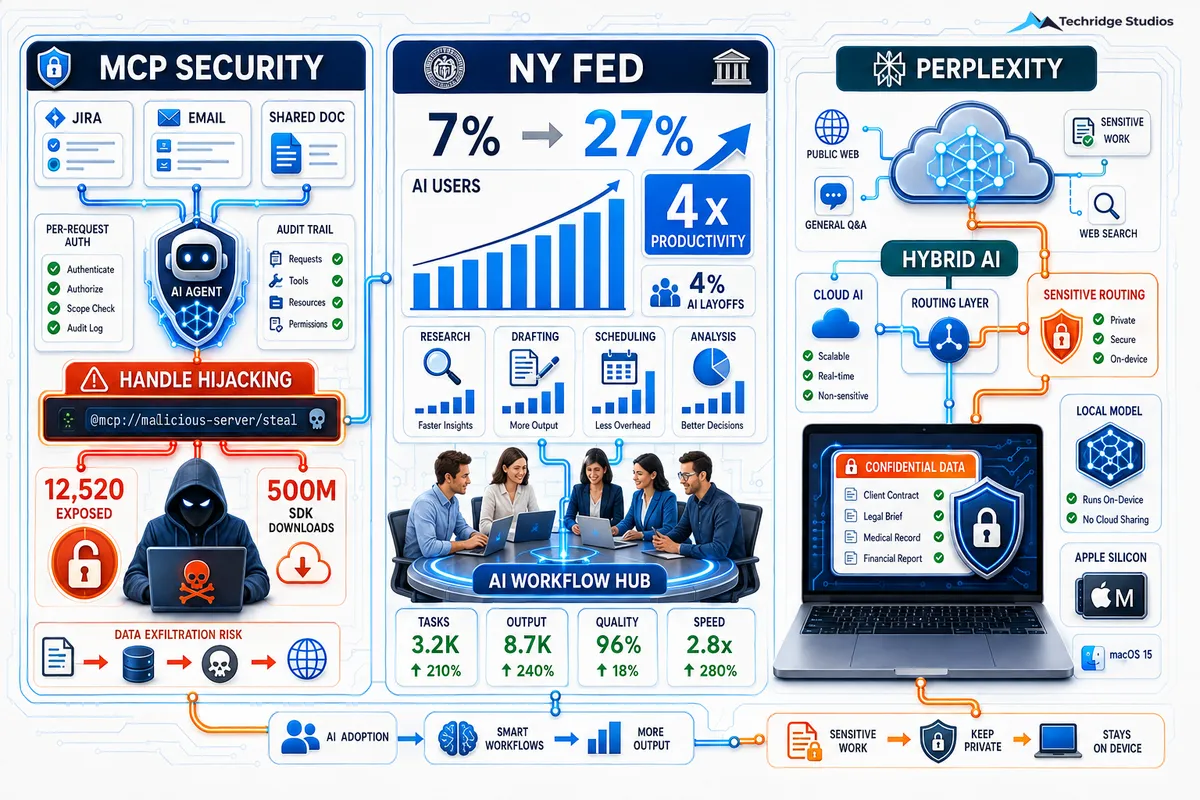
The Model Context Protocol — the standard that lets AI tools like Claude, Cursor, and ChatGPT connect to your business apps — pushed a significant spec update on July 28, 2026. That update made the protocol stateless, which was an architectural improvement. But a VentureBeat analysis published September 5th by security reporter Nik Kale reveals it also created three new attack surfaces that most businesses are not equipped to defend against.
The most dangerous is a technique called handle hijacking. When MCP became stateless, it introduced portable "handles" — small tokens representing a conversation's current state. The problem: those handles can be planted inside any content your AI agent processes. A malicious instruction embedded in a Jira ticket, a customer support email, or a shared Google Doc can inject a handle that passes your AI-connected account credentials to an attacker. No server breach. No password theft. Your agent just reads a file and hands over access.
There are two other attack surfaces. Stored cross-site scripting (XSS) in MCP apps can embed malicious HTML in AI-rendered interfaces. And network-layer security tools — which many businesses rely on to monitor traffic — can no longer see these new attack types because they operate below the network level.
The scale makes this urgent: 12,520 MCP services are currently exposed to the public internet. The MCP SDK has been downloaded over half a billion times per month. The NSA has issued guidance. Microsoft published research showing how tool-poisoning attacks cascade across connected systems.
For small businesses, the action today is simple: audit every MCP server your team is running. Ensure each one enforces per-request authentication rather than relying on session-level trust. Any AI agent that reads external data — emails, documents, tickets, web content — is a potential vector until you verify your defenses are current.
The New York Fed's Labor Day Data: AI Isn't Cutting Jobs — It's Creating a Productivity Gap
Every Labor Day involves some conversation about AI and the future of work. This year, the New York Federal Reserve provided concrete data rather than speculation.
Published September 1st, the Liberty Street Economics survey of New York and Northern New Jersey businesses found that companies in AI-exposed industries saw productivity growth jump from 7 percent to 27 percent — nearly quadruple the rate of businesses not using AI. Over the same period, only 4 percent of service firms reported laying off workers because of AI.
The finding is significant because it challenges both common narratives. AI is not primarily a cost-cutting or headcount-reduction tool, at least not in this data. And AI adopters are not simply doing the same work more efficiently — a nearly four-times productivity growth rate suggests they are accomplishing substantially more with the same team.
For small business owners, the implications are direct. Your competitors who have integrated AI into their core workflows — writing, research, analysis, scheduling, client communication — are not firing staff to get ahead of you on cost. They are just producing significantly more. The gap between AI-using teams and non-AI teams is already measurable.
The timing matters too. Labor Day historically marks the start of the fall push — Q4 planning, end-of-year projects, budget season. If you are going to make an AI adoption move, doing it before that period begins is better than doing it during it. Starting with one high-frequency workflow — weekly reports, client email drafting, meeting summaries — and running it through an AI tool for 30 days is enough to generate your own data point.
Perplexity's Hybrid AI: The First Agent That Keeps Sensitive Work On Your Machine
For professional service firms — legal, accounting, healthcare, creative agencies — the biggest barrier to AI adoption is not cost or capability. It is data. Client contracts, financial records, health information, and proprietary strategies are not things most firms can route through external servers, regardless of the vendor's privacy policy.
Perplexity addressed this directly on September 1st with the launch of a hybrid AI feature that begins tasks in the cloud and dynamically routes sensitive portions to a local model running on the user's Apple Silicon Mac (macOS 15 required). The task does not restart when it hands off — the handoff is seamless and determined by the sensitivity of the data being processed.
This is a first. Previous attempts at "local AI" required running the entire task on-device, which limits capability. Cloud AI gives you frontier performance but moves your data off your machine. Perplexity's hybrid approach is the first time a major AI agent can split a single task mid-execution across both environments based on what the data requires.
The feature is currently available to enterprise, Pro, and Max subscribers. It requires an Apple Silicon Mac running macOS 15. Android and Windows versions have not been announced.
For small businesses that have deferred AI adoption because of data security concerns, this changes the calculation. The question is no longer whether you can use AI responsibly on confidential work — it is whether your firm is running an eligible Perplexity subscription on the right hardware.
What This Means for Your Business
Three different stories, one through line: the competitive gap between businesses using AI and those that are not is widening, and the risks of doing it carelessly are increasing at the same pace.
Your single next action: if you are using AI tools connected via MCP, audit your endpoint authentication before the week ends. If you are not yet using AI in your core workflows, the Fed's Labor Day data is a concrete benchmark for how far behind you may already be. And if your hesitation is data security, Perplexity's hybrid model is worth a close look.
The brief is out every weekday at TechridgeStudios.com/insights.