Meta Doubles Down on SMBs, Slack Puts AI in the Chat, and Linear Proves More Output Isn't Speed
Three stories out of the AI space today paint a clearer picture of where business AI is actually landing in 2026: more access, more integration, and a productivity trap that is showing up in hard data.
Meta Gives Small Businesses a Free AI Control Room
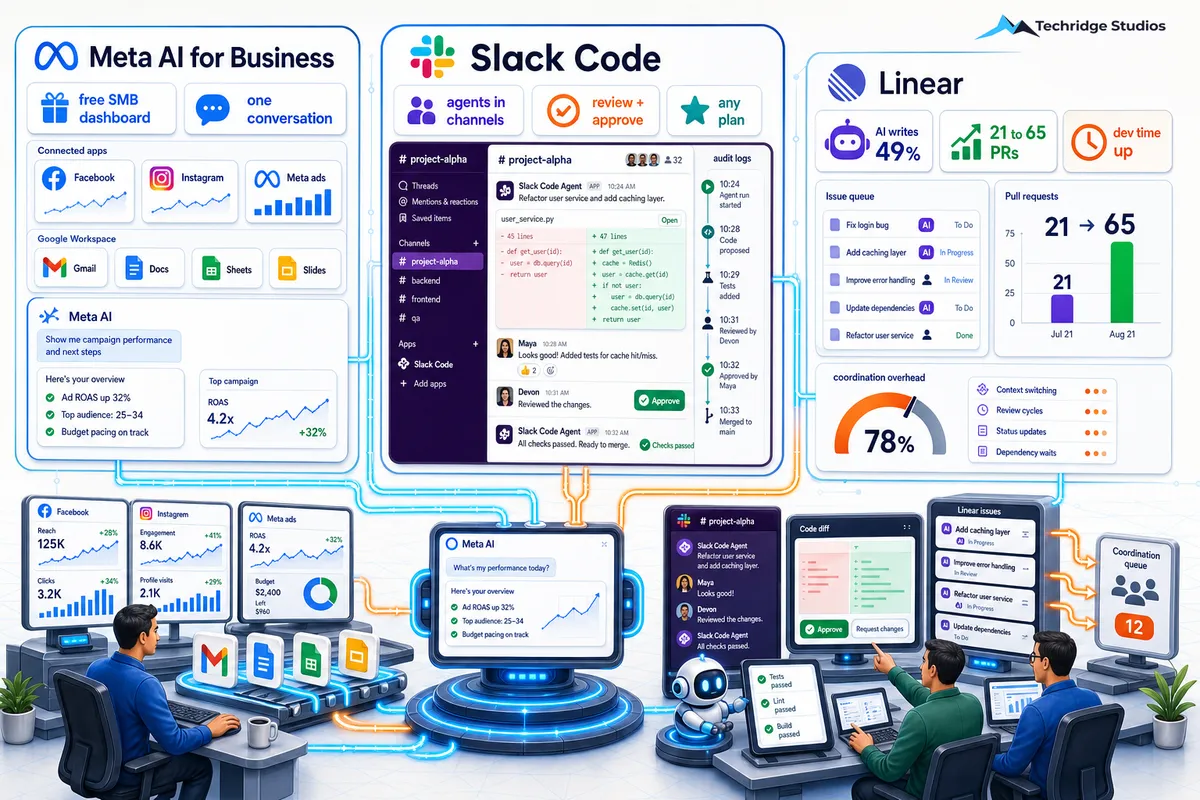
Meta announced on August 20th that it is rolling out a new AI-powered business assistant for small and medium-sized business owners. The tool connects your Facebook Page, Instagram account, Meta ad campaigns, and Google Workspace — including Gmail, Docs, Sheets, and Slides — into a single Meta AI conversation.
From that one interface, business owners can pull ad performance insights, review audience engagement data, generate documents and presentations, set recurring reminders, and get recommendations based on comparable brands. Meta AI can receive conversational prompts and return actionable suggestions without requiring you to navigate separate dashboards.
The feature is available immediately across meta.ai, the Meta AI mobile app, and the new Meta AI desktop app. The core tools are free to access. Meta has indicated that more advanced functionality will eventually require a subscription to Meta One, its upcoming business tier, but that pricing shift has not been announced with specific timing.
For small businesses that run Facebook or Instagram as their primary marketing channels, this is worth setting up today. The free tier consolidates tools that most owners were managing across multiple platforms and reduces the back-and-forth between ad data and content creation. The practical move: log into meta.ai, connect your accounts, and spend 30 minutes seeing what your current ad performance looks like through the unified view.
Slack Brings AI Coding Agents Into the Room With Your Whole Team
Slack launched Slack Code on August 20th, a new product that embeds AI coding agents directly into dedicated team channels. Rather than a single developer privately directing an AI coding tool, Slack Code allows the entire team to see the agent's work, comment on it, review code diffs, provide live feedback, and approve before anything ships.
Supported agents at launch include Claude Code, Cognition's Devin, GitHub Copilot, ChatGPT, and Vercel agents. Each agent works inside a project-specific channel. When the assignment wraps, the channel archives itself, and a full audit log is kept for record-keeping.
Slack Code is available on any Slack plan from today, though customers need their own access to the partner agents they choose to use. That means the access point is Slack — which most business teams already pay for — and the only additional cost is the agent itself.
The SMB implication here is the shift from AI as a private developer tool to AI as a visible, team-managed resource. Non-technical business owners can now participate in the software development process without needing to understand the underlying tools. If you are using a freelancer or small dev team and you are all on Slack, Slack Code gives you a shared window into what the AI is doing rather than waiting for a result.
Linear Data: AI Is Writing Half the Issues, but Development Is Still Getting Slower
Linear, the project management platform popular with software teams, published a report today based on aggregated data from its paid workspaces, comparing June 2025 to June 2026.
The headline is striking: two years ago, fewer than one in a thousand project issues were authored by AI. Today, AI authors just under half of everything created in Linear. Teams using coding agents went from an average of 21 pull requests per week to 65. CEO-level adoption in companies over 200 employees jumped from 9 percent to 36 percent.
Here is the data point that cuts against the narrative: total product development time still went up. The agents tripled output but added overhead rather than reducing it. Engineers spent more time creating context, triaging agent-generated issues, and reviewing output. The coordination work for directing AI fell to the same people who were already doing it.
For small businesses, the lesson is specific. More AI activity does not mean fewer hours. If you deploy coding agents or AI assistants without a clear system for managing their output, you may end up with more to review, not less to do. The businesses seeing real-time savings are the ones that have built the handoff process, not just the tool access.
What This Means for Your Business
Today's stories share a common thread: AI is becoming more woven into the platforms you already use. Meta, Slack, and the teams running in Linear are not asking you to add a new tool. They are bringing AI into the place you already work.
The single most useful action you can take today is this: log into meta.ai and connect one data source — your Facebook Page or your Google Workspace. You do not need to overhaul your setup. Spend 30 minutes seeing what Meta AI surfaces and whether it changes anything about how you interpret your marketing data. That is the lowest-risk test of whether this integration earns time in your workflow.
Sources
Social Media Today — https://www.socialmediatoday.com/news/meta-adds-ai-powered-assistant-for-smb-owners/828344/
VentureBeat — https://venturebeat.com/orchestration/slack-wants-to-drag-ai-coding-out-of-the-terminal-and-into-the-group-chat
AIToolsRecap — https://aitoolsrecap.com/Blog/ai-news-august-21-2026