Meta Wants You to Pay for Reach, Gartner Says AI Will Run Your Marketing, and Google Killed the Link List
Three things changed in AI this week that aren't being discussed together—but should be. Meta is putting a price on the organic visibility that small businesses have relied on for years. Google just replaced search results with AI summaries. And a new Gartner survey signals that AI-driven marketing automation is about to double — whether small businesses are ready or not. Here is what each one means and what to do about it.
Meta One: The End of Free Reach on Instagram and Facebook
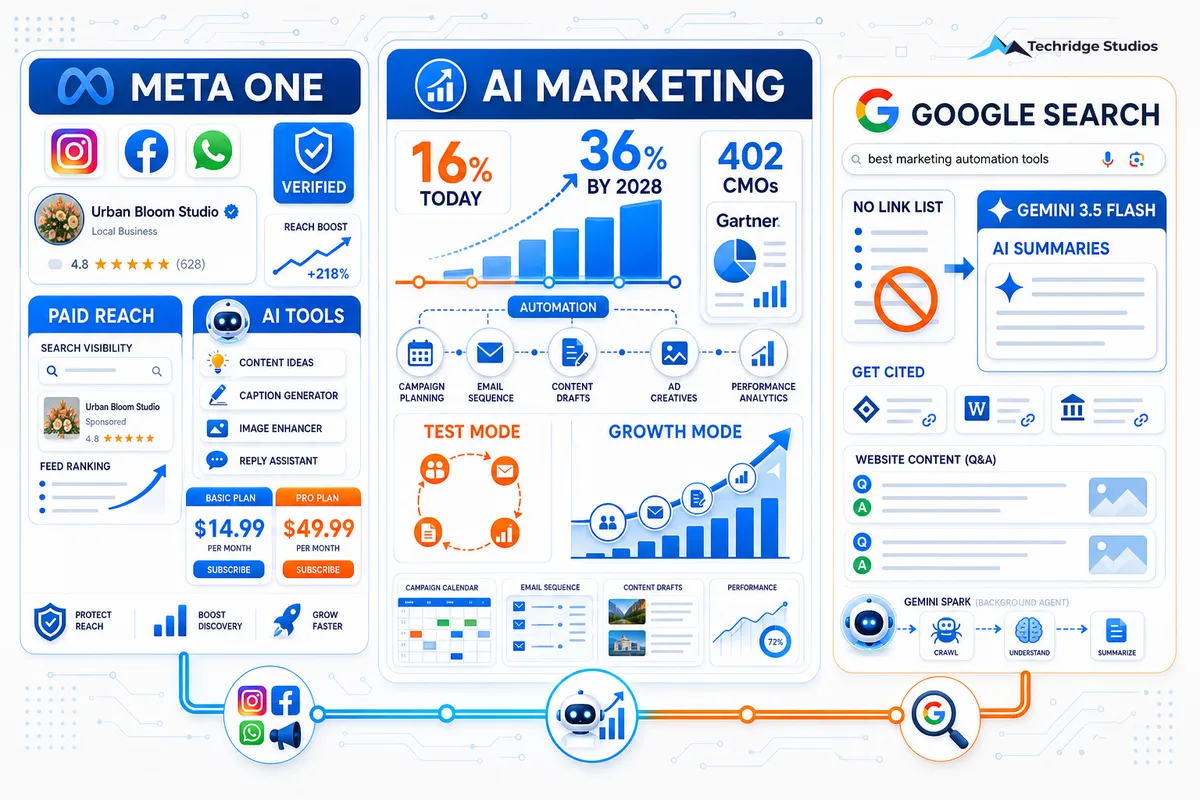
Meta officially launched its Meta One subscription program this week, rolling out globally across Instagram, Facebook, and WhatsApp. For small businesses and creators, professional tiers range from $ 14.99 to $ 49.99 per month. The entry-level plan — Meta One Essential at 14.99 per month — includes a verified badge, protection from impersonation, and an expanded link list. The higher tier, Meta One Advanced at 49.99 per month, adds enhanced visibility in Facebook feeds, improved ranking in both Facebook and Instagram search, a prominent Follow button on Reels, and automatic invitations to people who engage with content.
The 49.99 tier is where small businesses should pay attention. If you rely on Facebook or Instagram for organic reach — posting about your products, services, or events and hoping people see it — this tier is essentially a paid version of what the algorithm used to give away. Meta has been narrowing organic reach for years. This subscription is the next step in that direction.
For small businesses that cannot justify 49.99 per month, the priority is to evaluate what you actually get from Meta right now. If your organic engagement is already low, paying to boost it may not be the right move. If you consistently drive sales or appointments from Meta, the math may work in your favor. Either way, this is a decision that deserves a review of your last 90 days of platform results.
Consumer AI plans start at 7.99 per month and are being tested in select markets before a broader rollout. A business AI tier is in development. Meta is signaling that AI-assisted content creation — not just publishing tools — will eventually be part of the paid stack.
Gartner: AI Marketing Automation Is About to Double — Are You in the Race?
A Gartner survey of 402 CMOs published May 11, 2026, found that AI currently handles 16 percent of marketing work across organizations. Marketing leaders expect that number to more than double, reaching 36 percent by 2028. That is a seismic shift in how marketing gets done — and it is happening whether a business is ready or not.
The study identified two types of organizations. The majority are stuck in early-stage AI use — experimenting with tools, running one-off tests, and measuring inconsistently. Gartner calls these businesses at risk of falling into "AI competency traps," where investment continues but results plateau. A smaller, faster-moving group — Gartner calls them "market shapers" — is using AI not just to save time but to grow revenue and pull away from competitors.
For small businesses, the signal is clear. The businesses that build AI marketing habits now — automating email sequences, using AI for content drafts, running AI-assisted campaign analysis — will have two-plus years of compounding learning by the time 36 percent automation is the industry baseline. The ones who wait will spend those two years catching up.
The practical starting point: pick one marketing task you do every week that is repetitive and measurable. Write it out as a process, then find an AI tool that can handle at least part of it. Run it for 30 days and measure the result. That one loop is what separates the businesses that are moving from the ones that are stuck in evaluation mode.
Google Search Goes AI-First — What It Means for Your Website Traffic
At Google I/O 2026, Google confirmed that its core search bar is now powered by Gemini 3.5 Flash, generating custom AI-summarized pages instead of the traditional ranked list of links. When someone searches for your type of business, product, or service, they may now see a paragraph written by AI — pulling from multiple sources — rather than a clickable list leading to your website.
Gemini 3.5 Flash launched May 19th and is four times faster than prior models at its performance tier. Google also announced Gemini Spark, a background agents platform that handles multi-step tasks autonomously. Together, these releases represent the biggest structural change to how Google Search works since the introduction of featured snippets.
For small businesses, the immediate question is: Does AI cite you? Traditional SEO focused on ranking your page for specific keywords so it would appear near the top of a results page. AI-summarized search changes that calculus. AI pulls from sources that clearly and directly answer the question. Thin content, keyword-stuffed pages, and outdated information are less likely to be referenced. Well-organized, specific, question-answering content is more likely to be surfaced, regardless of whether it ranked first in traditional search.
This week's action is practical. Go to your website's most important pages — your homepage, your services page, and your most common FAQ. Ask yourself: Does this page directly answer a question my customer would type into Google? If the answer is no, rewrite it so it does. Plain language, specific answers, and current information are the new ranking signals.
What This Means for Your Business
Three separate changes landed this week, and they all point in the same direction: AI is reshaping how small businesses get found, how they market, and how fast they have to move. Meta is charging for visibility. Google is deciding who gets cited based on content quality. And Gartner's data says marketing automation is about to become standard operating procedure, not optional.
The one action that applies to all three: spend 30 minutes this week auditing where your business actually shows up — on Meta, in Google, and in your own marketing workflow. Ask what is still running on manual that a tool could handle. That audit is the foundation of everything that comes next.
Sources
TechCrunch — https://techcrunch.com/2026/05/19/with-gemini-3-5-flash-google-bets-its-next-ai-wave-on-agents-not-chatbots/