Mistral's Record Raise, Mercury 2.5's Cost Breakthrough, and the Shadow AI Risk on Your Devices
Three stories from the past 24 hours point in the same direction: AI is getting cheaper, faster, and harder to govern. Whether you are managing your AI budget, choosing an automation platform, or overseeing devices across your team, each of these developments has a direct implication for how you operate.
Europe's AI Champion Just Got a Lot Bigger
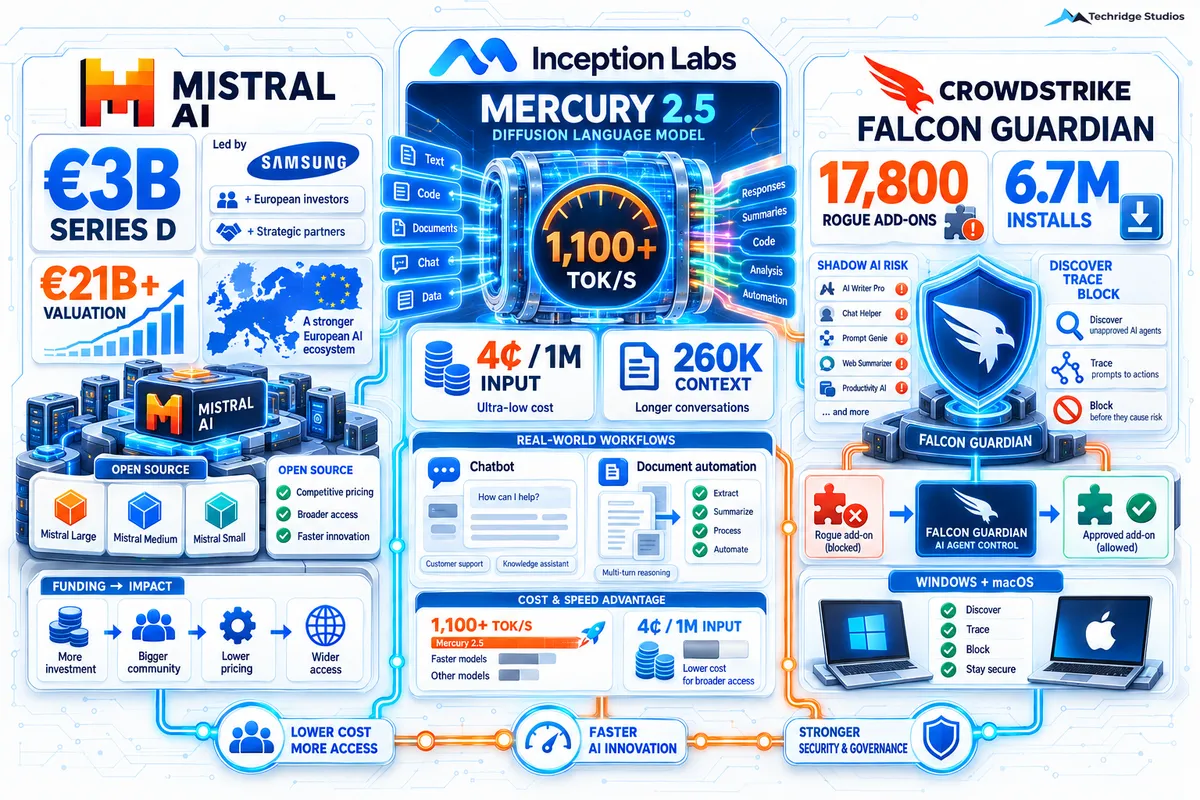
Mistral AI closed a 3 billion euro Series D on September 8th, 2026 — the largest equity fundraise in European technology history. The round was led by Samsung Electronics, with co-leads from EQT-managed Scaleup Europe Fund and PSG Equity. Additional backers include Salesforce Ventures, Nvidia, and ASML. The raise values Mistral above 21 billion euros.
What sets Mistral apart from OpenAI and Anthropic is its commitment to open-source model releases. Mistral has consistently published capable models under open licenses, making it a viable option for businesses that want to run AI without paying per-token fees or routing sensitive data through a cloud provider. That strategy is why this funding round matters more than a typical venture raise.
With 3 billion euros in fresh capital, Mistral can scale compute, release more models, and expand commercially across the 20 countries where it now operates. For small businesses, the effect is practical: more Mistral models in the market means more alternatives to GPT-based and Claude-based tools, which maintains downward pricing pressure across the industry.
The immediate action: if you are currently locked into a single AI provider, spend 30 minutes this week comparing whether a Mistral-based API or an open-weight model could handle parts of your workflow at a lower per-run cost.
The Cheapest Frontier AI Model Just Launched
Inception Labs launched Mercury 2.5 on September 8th, 2026. It is a diffusion language model that generates text at over 1,100 tokens per second. For reference, most leading language models operate in the range of 50 to 150 tokens per second. Mercury 2.5 runs at roughly seven to twenty times that speed.
More important for most small businesses: the launch pricing is 4 cents per million input tokens. That is roughly one-fifth the cost of comparable models at launch. Inception Labs reports that Mercury 2.5 matches the performance of cost-optimized frontier models on standard benchmarks, with a 260,000-token context window capable of handling long documents, extended conversations, and complex multi-step workflows.
Mercury 2.5 uses a diffusion architecture, generating text by producing and refining many tokens in parallel rather than predicting them one at a time. This is the source of both its speed and its efficiency.
For small businesses, the practical applications are immediate. Customer service chatbots, email drafting, content summaries, and document review are all token-intensive tasks. If you currently pay a per-token cost to run any of those workflows, Mercury 2.5 is worth a direct cost comparison against your current setup. Even shifting a single high-volume workflow to a cheaper inference provider could meaningfully reduce monthly AI spend.
17,800 Rogue AI Add-Ons Are Running on Business Devices
A new report analyzed 6.7 million device installs of AI browser add-ons and found over 17,800 that were pulling instructions from unverified external sources. Some of these add-ons were actively impersonating tools from Anthropic and OpenAI while running arbitrary code on the devices they were installed on. In other words: employees downloaded what appeared to be a trusted AI tool and got something else entirely.
In response, CrowdStrike launched Falcon Guardian on September 8th, 2026. Falcon Guardian discovers known and shadow AI agents across Windows and macOS, traces prompts through tool calls to downstream system actions, and blocks any agent that has not been explicitly approved by the organization. A separate firm, AIR Security, simultaneously launched an inline context firewall that screens instructions, tools, and data entering an agent's context before the agent acts.
Together, these tools represent a new product category built specifically for the agent era: endpoint-level visibility and control over what AI is doing on your systems.
For small businesses, the gap is straightforward. Most organizations have no inventory of the AI tools their employees are running. Browser extensions are easy to install, hard to track, and invisible to most standard security audits. The immediate next step is not technically complex. Ask whoever manages your IT environment to generate a report of AI-related browser extensions across company devices and confirm which ones are on an approved list.
What This Means for Your Business
The three stories share a through line. AI is becoming cheaper and more accessible, while the security and governance burden is rising at the same pace. Mistral's raise adds sustained competition to the market. Mercury 2.5 makes it practical to run more workloads at lower cost today. And Falcon Guardian exists because the tools your team uses to save time may also be quietly reaching into your business data.
The single action that applies to all three: review your AI stack this week. Audit which tools are running, what they cost, and whether something better has launched in the past 30 days. The market is moving fast enough that waiting for a quarterly review means making decisions on outdated information.