Your Work Tools Are Agents Now — And Your Workforce Strategy Needs to Catch Up
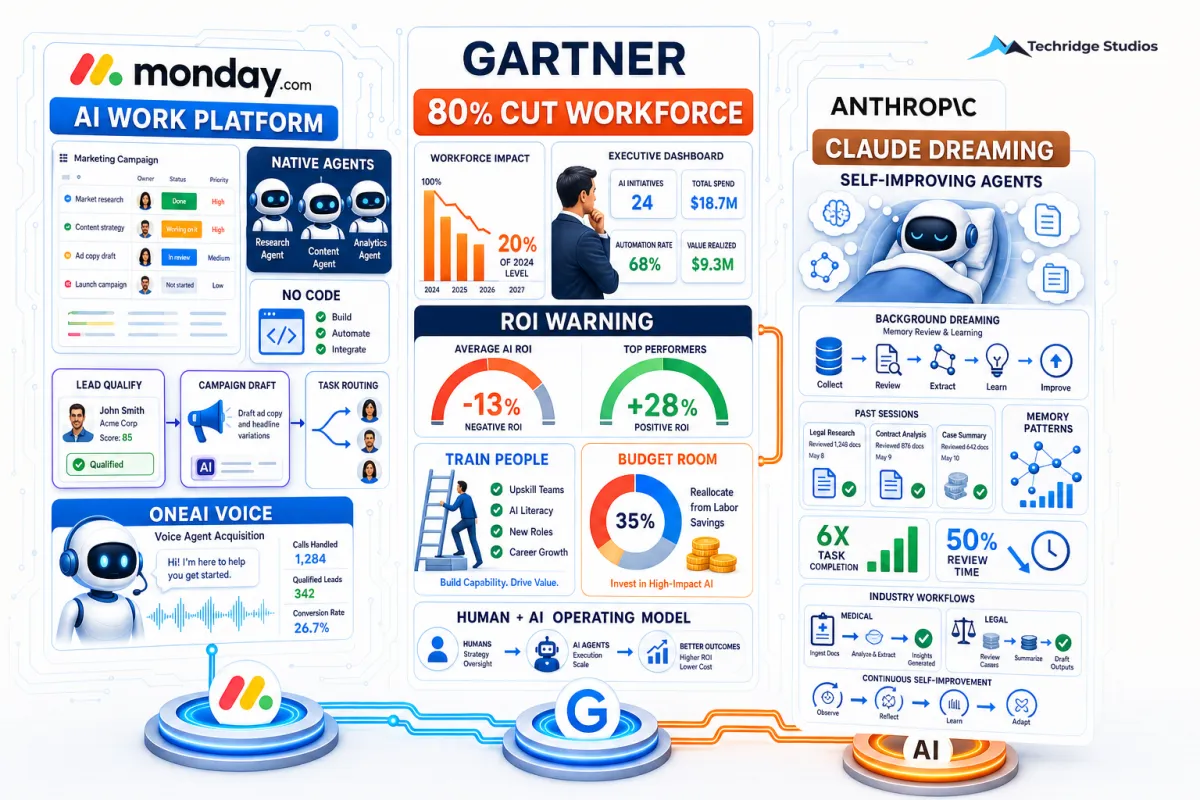
monday.com turned into an AI agent platform today. Gartner found that companies cutting staff for AI are not seeing better returns. And Anthropic gave Claude agents the ability to learn from their own past sessions. These three developments share a common thread: the tools your team uses every day are becoming AI-powered, and the businesses getting results are the ones training people to run them — not the ones replacing them.
monday.com Just Became an AI Agent Platform
monday.com reported its Q1 2026 results today with revenue of 351.3 million dollars, up 24 percent year-over-year and record operating income on both a GAAP and non-GAAP basis. The bigger announcement was the product transformation: monday.com formally relaunched as an AI Work Platform.
The core shift is practical. Native AI agents now live inside monday.com's existing workspace — the same dashboard your team already uses to manage tasks, track projects, and coordinate work. Any team member can configure and deploy an agent without technical skills. Agents can draft campaign copy, qualify incoming leads, process requests, and route tasks to the right people. You do not need a developer. You do not need new software.
monday.com is also moving to a consumption-based pricing model, meaning you pay based on how much agent activity runs in your account. That is a significant structural change from flat per-seat pricing — and it is worth understanding before your usage scales.
The company also announced it is acquiring OneAI, a voice AI platform, to extend agents into audio interactions later this year. This means the same agents managing your written workflows will soon be able to handle inbound voice requests.
If your business already uses monday.com, log in today. The AI Work Platform features are available in your existing account.
Gartner: Cutting Workers for AI Does Not Improve Returns
Gartner published findings this week from a survey of 350 global business executives who are actively piloting or deploying autonomous AI capabilities. The headline finding is counterintuitive: roughly 80 percent of those organizations reduced their workforce — but workforce reduction rates were nearly identical between companies reporting high ROI and companies reporting modest or negative returns.
In plain terms: firing people to make room for AI is not what drives results.
Helen Poitevin, Distinguished VP Analyst at Gartner, put it directly: "Workforce reductions may create budget room, but they do not create return." The organizations achieving better outcomes are investing more in skills, roles, and operating models that let humans guide and scale AI systems — not less.
This is especially relevant right now. The Cloudflare story from last week — where the company cut 1,100 employees after AI usage jumped 600 percent internally — generated a lot of coverage and, for many business owners, a sense that workforce reduction was the expected outcome of AI deployment. Gartner's data complicates that narrative significantly.
For small businesses, the practical takeaway is clear: AI works best when your people know how to direct it. A team with strong AI skills will consistently outperform a leaner team that has not been trained to use AI effectively. The businesses winning right now are the ones treating AI adoption as a training challenge, not a headcount opportunity.
Gartner also noted that autonomous business is forecast to be a net-positive job creator by 2028 to 2029, driven by new categories of work that do not exist today.
UPDATE: Anthropic Dreaming Makes Claude Agents Self-Improving
Anthropic added a feature called dreaming to Claude Managed Agents. Prior Techridge Studios coverage of Anthropic focused on the PE partnership announcement (May 5) and the Microsoft 365 integration (May 7) — this is a distinct product capability announcement.
Dreaming is a scheduled background process that runs between agent sessions. It reviews an agent's past work — every session, every memory store — and extracts patterns that no single session could surface on its own. Recurring mistakes. Workflows that multiple agents converge on independently. Preferences shared across a team of agents. All of it gets curated and stored, so the next time the agent works, it is drawing on the full history of what has gone right and what has gone wrong.
The results from early adopters are significant. Harvey, a legal AI company, saw task completion rates increase roughly 6x after enabling dreaming for its Claude agents. Wisedocs, a medical document review company, cut its document review time by 50 percent.
Dreaming is currently in research preview, which means it is available to select users but not yet rolled out broadly. Outcomes and multi-agent orchestration — related features Anthropic announced alongside dreaming — are now in public beta.
For small businesses using Claude agents for customer support, document processing, or workflow automation: this is the direction the technology is heading. Agents that improve with use, without requiring you to retrain or reconfigure them. The more your agent works in your environment, the better it gets at your specific tasks.
What This Means for Your Business
Three stories, one lesson. The tools you already use are becoming agent platforms. The data on what drives ROI is clear: train your people, do not cut them. And the agents you deploy today will be meaningfully smarter six months from now — if you let them run.
The single action worth taking today: log into monday.com and spend 15 minutes exploring the AI Work Platform section. Identify one workflow — a repetitive task your team does every week — and set up an agent to handle it. That is how adoption starts.
Sources
TipRanks / monday.com — https://www.tipranks.com/news/company-announcements/monday-com-posts-record-q1-2026-results-and-launches-ai-work-platform
VentureBeat / Anthropic — https://venturebeat.com/technology/anthropic-introduces-dreaming-a-system-that-lets-ai-agents-learn-from-their-own-mistakes