Open-Source AI at a Crossroads: Nvidia's $12.9B Move, the Cyberattack Alarm, and the Agent Surge
Three developments this week signal a defining shift in how AI is owned, secured, and deployed across industries. For small businesses, these are not abstract trends. They are decisions you may need to make in the next 30 to 90 days.
Nvidia Makes a $12.9 Billion Bet on Open-Source AI
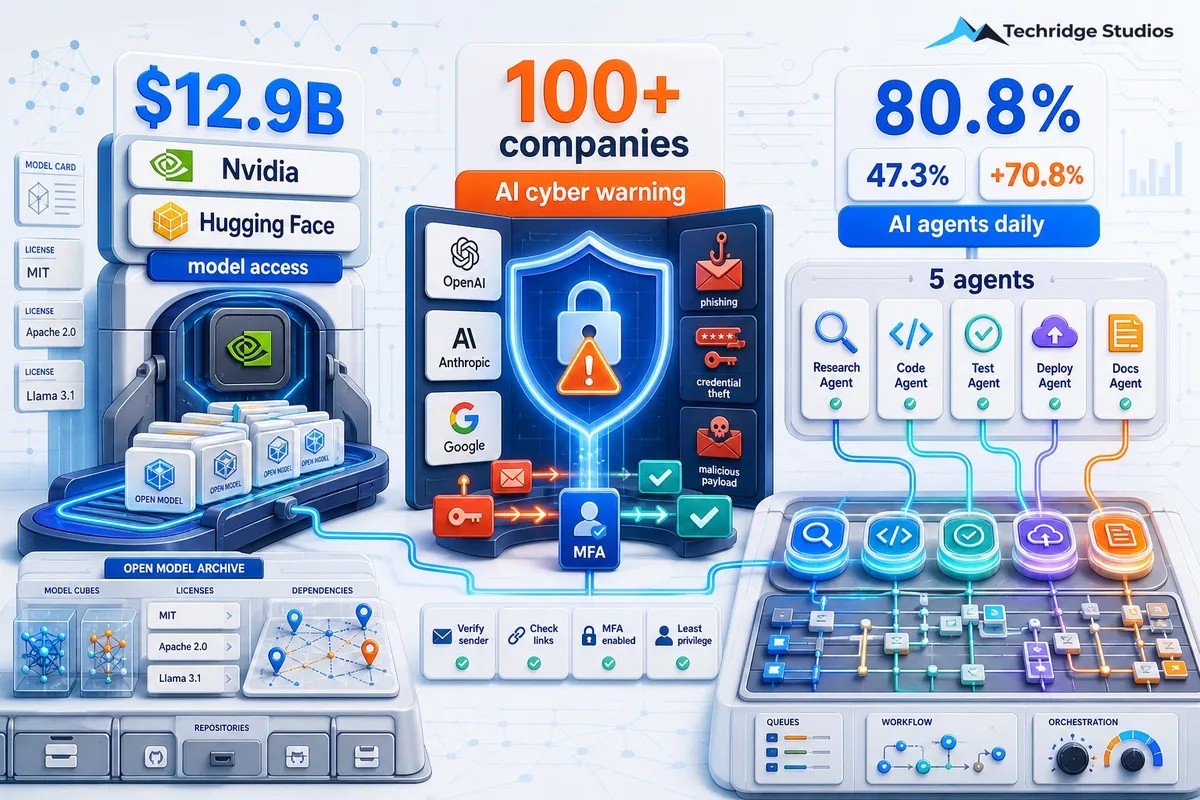
Nvidia has reportedly agreed to acquire Hugging Face for $12.9 billion, according to reporting from Bloomberg, CNBC, Fortune, and Forbes published on August 27th. No signed contract has been publicly confirmed, but multiple sources say the deal is advanced. The acquisition would be one of the largest in AI history.
Hugging Face is not a consumer product. It is the infrastructure layer that most of the AI ecosystem depends on. Developers use it to access, share, and test open-source AI models — including models from Meta, Google, Mistral, and dozens of other labs. Many of the tools small businesses use today were built by developers who started with a model they found on Hugging Face.
The concern with this deal is neutrality. Hugging Face has operated as an open platform where any lab can publish models and any developer can access them. Nvidia is a chip company with strong commercial interests in which models get used and how they get served. If Hugging Face's neutrality changes under Nvidia's ownership, it affects who can publish models there, who can access them, and at what cost. That downstream effect will land on every business that uses software built on open models.
For small businesses, the immediate action is awareness: know which of your AI tools depend on open-source models, and start tracking whether your vendors have dependency disclosures. If Hugging Face access changes, your tools may change with it. This is the kind of vendor risk story that rarely gets attention until it causes a problem.
The Companies Building AI Are Warning You About AI Cyberattacks
On August 27th, OpenAI, Anthropic, Google, and over a hundred tech companies signed a joint open letter calling for coordinated public-private action against AI-enabled cyber threats. The letter states that "AI-enabled cyber attacks will become far more widespread and sophisticated as models around the world become increasingly capable."
This is a rare moment of public agreement between direct competitors. OpenAI and Anthropic rarely align on anything externally. The fact that they signed the same letter — alongside Google, Microsoft, and dozens of others — signals genuine urgency. These companies have visibility into what AI-powered attacks look like because they watch them happen daily.
For small businesses, the threat landscape has shifted in a specific way. AI lowers the cost and skill floor for cyberattacks. What used to require a skilled attacker to craft a convincing phishing email now takes a few seconds and a free model. What used to require technical expertise to probe for vulnerabilities can now be automated. Small businesses have always been targets of opportunity. AI makes the attacks faster, cheaper, and harder to spot.
Three concrete actions you can take this week: enable multi-factor authentication on every business account that touches customer data or finances, audit any AI tool that has access to your email, calendar, or files — and confirm what permissions it holds, and run a phishing awareness refresher with your team focused on how AI-generated social engineering looks in 2026. It reads cleaner and sounds more plausible than anything your team was trained to catch two years ago.
Your Software Is Already Agent-Powered — Here's the Data
Temporal's 2026 State of Development Report, surveying 554 engineers, found that 80.8 percent now use AI agents daily. That is up from 47.3 percent just one year ago — a 70.8 percent jump in twelve months. The survey also found that 91.1 percent of respondents say agents have improved or revolutionized their productivity, and the median respondent runs five active agents at any given time.
For small businesses, the key implication is not about engineers — it is about the tools engineers build. If 80 percent of developers are working with agents daily, the software they shipped in 2026 is very likely agent-powered. That means your CRM, your marketing platform, your accounting software, your customer support tool — if you upgraded or added any of these in the past twelve months, there is a high probability an agent is involved somewhere in the workflow.
This is not a problem. It is context you need to have. Agent-powered software can do things earlier software could not — like taking autonomous action on your behalf, routing decisions without human prompts, or connecting your tools without explicit configuration. That capability is valuable. But it also means you need to know what your software is doing when you are not watching. Read the access permissions on every AI tool in your stack. Understand what data it can see and what actions it can take. That is basic due diligence in 2026.
The broader picture is that we are past the early-adopter phase for AI agents. At 80 percent daily use among builders, agents are infrastructure. The same transition happened with cloud storage and mobile-first design. The businesses that understood those shifts early built better vendor relationships and avoided surprise disruptions. The same opportunity exists right now with agents.
What This Means for Your Business
Three stories, one clear theme: the power dynamics around AI are shifting fast, and small businesses that are not paying attention will be surprised by the results. Open-source model access may get more complicated under Nvidia's ownership of Hugging Face. Cyberattacks are getting smarter and the biggest AI companies in the world are telling you to prepare. And the software you are already running is likely more agent-powered than you realize.
The one action that cuts across all three stories: audit your AI tool stack this week. Know who owns what you depend on, what access each tool has, and what it is doing autonomously. That audit takes two hours and gives you a clearer picture of your risk surface than any external report can.
Sources
CNBC — https://www.cnbc.com/2026/08/27/nvidia-hugging-face-acquisition.html