Your Business Devices Are Getting an AI Upgrade This Week
Three major platform announcements landed in the same seven-day window. NVIDIA unveiled a chip that runs AI agents offline. Google released its fastest AI model to date. And Apple is one week away from showing what an AI-native iPhone looks like. Here is what each development means for a business with under 200 employees.
NVIDIA RTX Spark: AI Agents Now Running Without the Cloud
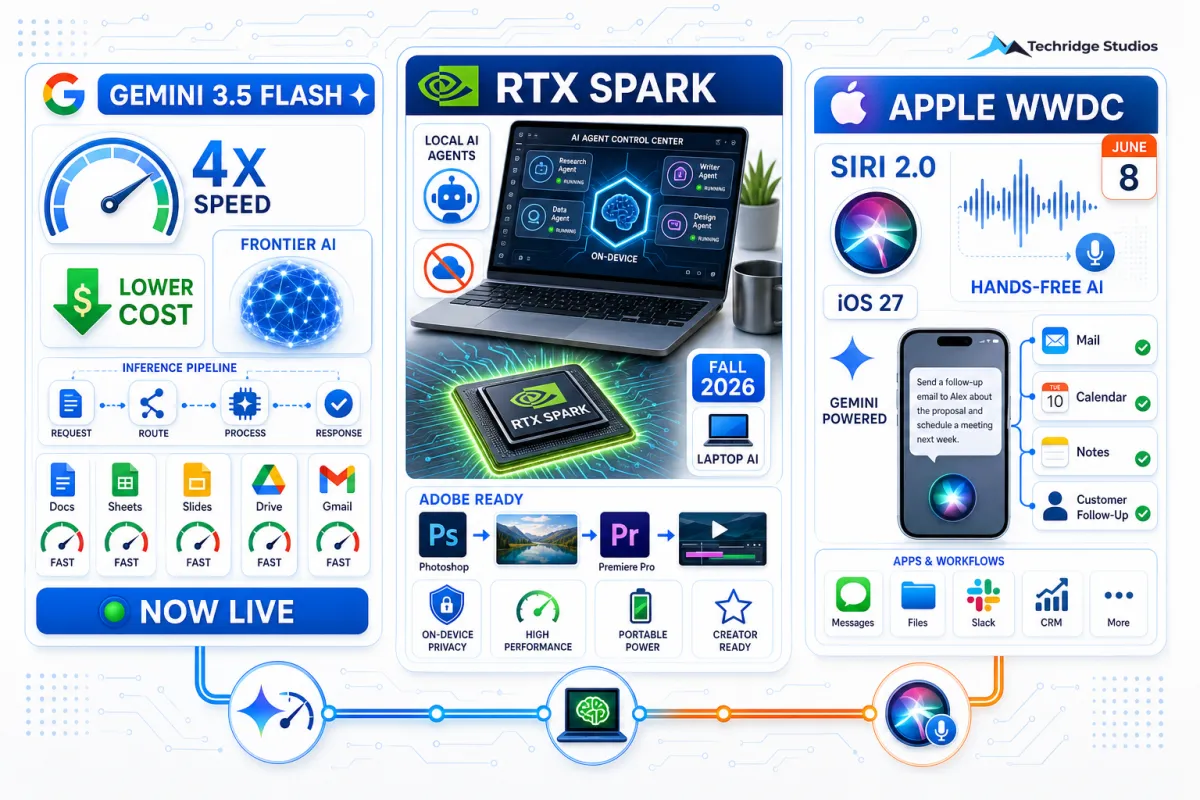
On June 1st, Nvidia CEO Jensen Huang took the stage at GTC and announced RTX Spark, a new superchip that consolidates AI agent processing, content creation, and gaming onto a single portable chip. The key word is local. RTX Spark runs AI workloads directly on the device — no API call, no cloud subscription, no usage fee per query.
Adobe confirmed that it is rebuilding Photoshop and Premiere Pro on the RTX Spark architecture. That means creative tools your team already uses will run AI-native features entirely on-device. Laptops powered by RTX Spark are expected to launch in fall 2026. Pricing has not been released.
For small businesses, the financial implications are significant. Today, running AI tools at any meaningful scale requires paying for API access, cloud compute, or SaaS subscriptions that meter usage. RTX Spark changes the cost structure. A single hardware purchase could replace months of recurring AI spend for teams that use AI for content, design, or internal operations.
The practical action right now: hold off on new laptop purchases until fall pricing is announced. If you are currently paying per-use for AI tools your team runs daily, that expense may be worth revisiting in Q4.
Gemini 3.5 Flash: Google's Fastest Model Is Now Open to Everyone
Google released Gemini 3.5 Flash to general availability on June 1st. The headline number: frontier-level intelligence at four times the speed of comparable models. It is Google's most cost-efficient model to date, and it is now available to any developer or business building on Google's AI infrastructure.
For context, most of the AI-powered features in tools like Google Workspace, Google Ads, and third-party apps built on Google's platform use Google's inference models under the hood. When those models get faster, the features you use get faster too — without any action on your part.
Gemini 3.5 Flash is also positioned directly against OpenAI and DeepSeek on price. As these models compete for developer adoption, inference costs continue to fall. That pressure flows downstream to the SaaS tools and platforms that small businesses rely on.
The practical action: if you are evaluating AI platforms or tools right now, ask your vendor which underlying model they use. Tools built on Gemini will benefit from today's release. If a vendor cannot answer that question, it is worth asking why.
Apple WWDC 2026: Siri 2.0 Is Coming to Your iPhone
Apple's Worldwide Developers Conference opens June 8th at 10 AM Pacific. Developer leaks, internal Apple documentation, and pre-conference briefings all point to the same headline: iOS 27 will launch Siri 2.0, a conversational AI assistant powered in part by Google Gemini.
The current Siri is a command-and-response tool. Siri 2.0 is being rebuilt as a context-aware assistant that can maintain a conversation across apps, understand nuanced requests, and take multi-step actions. Early builds show that it integrates directly with Mail, Calendar, Notes, and third-party apps.
For a small business owner, the practical applications are immediate. Imagine asking your iPhone to pull the last email from a client, draft a follow-up based on what was discussed, and add a reminder to check in next week — without switching apps or touching a screen. That is the direction Siri 2.0 is heading.
The tradespeople, field service workers, retail owners, and anyone else who spends their day away from a keyboard will benefit most from this shift. Voice-first AI on a device that is already in your pocket is different from an AI tool you have to open on a laptop.
What This Means for Your Business
This week marks a convergence of platform-level AI changes: hardware, model infrastructure, and device operating systems are all shifting at once. None of these stories requires you to buy something today. But each one should inform a decision you make in the next 90 days.
If your team spends money on cloud AI tools, watch the RTX Spark laptop pricing in fall 2026. If you build or buy tools that run on Google's infrastructure, Gemini 3.5 Flash means those tools just got faster for free. And if your business runs on Apple devices, attend or watch the WWDC keynote on June 8th. The Siri overhaul is the kind of change that creates new workflows for businesses that adapt early and leaves others catching up later.
The one action to take today: write down the three tools your business uses most that involve AI in any form. Over the next week, find out which AI models power them. That single piece of information will tell you how much of this week's news already affects your day-to-day.
Sources
AI Updates Today — https://llm-stats.com/llm-updates
MacRumors — https://www.macrumors.com/roundup/wwdc/