OpenAI's New Chip, Figma's AI Builder, and a Spending Gap That Should Concern Every SMB
Today's stories share a common thread: the cost and accessibility of AI are shifting faster than most small businesses are acting. OpenAI just revealed the infrastructure behind the next round of AI price drops. Figma made creating custom tools accessible to anyone who can type a sentence. And new data from Ramp shows the gap between businesses that use AI strategically and those that don't is now 680 times wide.
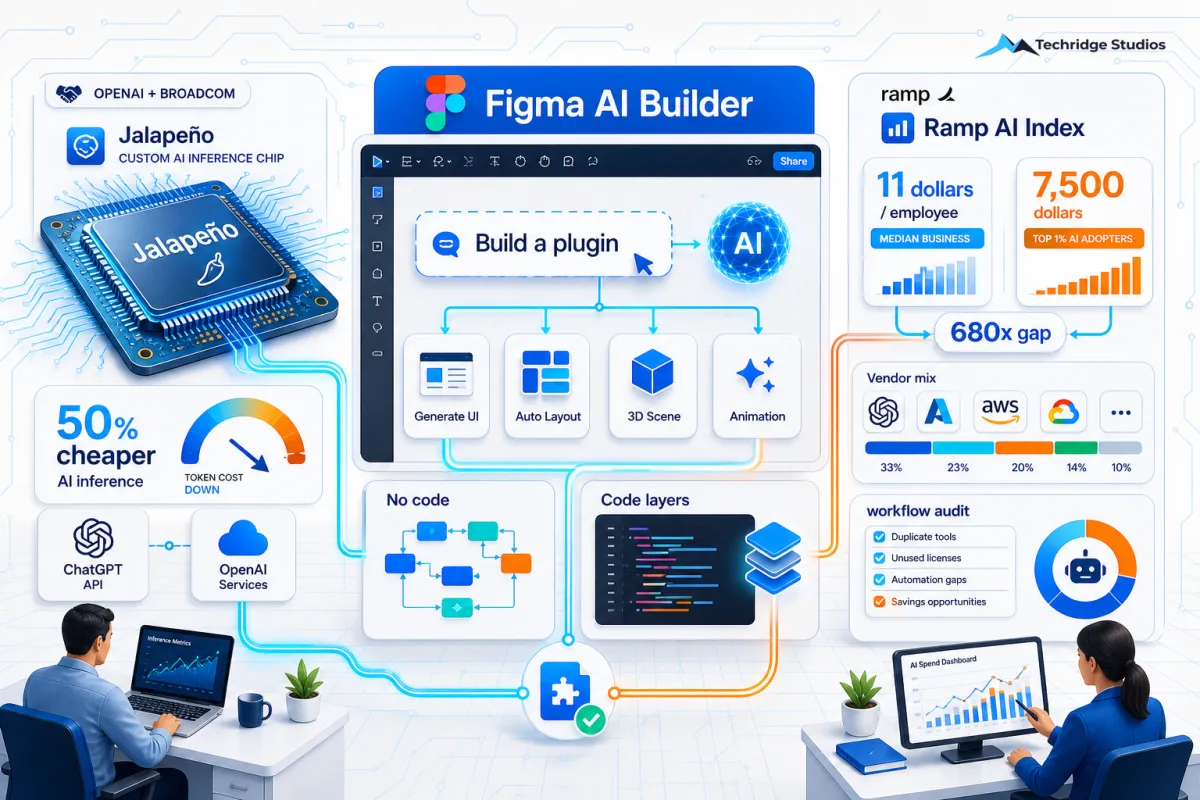
OpenAI and Broadcom Unveil Jalapeño — A Custom Chip Built to Cut AI Costs in Half
On June 24th, 2026, OpenAI and Broadcom unveiled Jalapeño — OpenAI's first custom AI inference chip. Built in nine months using OpenAI's own AI models to accelerate the design process, the chip is purpose-built to run large language model inference more efficiently than current-generation GPUs. Early lab benchmarks suggest approximately a 50 percent cost reduction per inference token, though OpenAI has noted that these are self-reported numbers from workloads of its choosing, not independently verified comparisons.
The chip was manufactured by TSMC and will begin prototype deployment in late 2026. Full production ramp happens through 2027, with broad deployment expected in the first half of 2028. OpenAI President Greg Brockman stated the company wants to "build the full stack" — owning more of the infrastructure used to serve AI to users and businesses.
For small businesses, the direct implication is not immediate. Jalapeño's cost benefits will take one to two years to translate into lower pricing on ChatGPT plans and OpenAI API rates. But the direction of the economy is clear. When a major AI provider cuts its own compute costs in half, that margin either goes to the provider or eventually gets competed away into lower prices for buyers. Given how competitive the AI market is right now, the latter is the more likely outcome.
If your business is currently paying for ChatGPT Plus, a Team plan, or OpenAI API access, watch pricing announcements in the second half of 2026 and into 2027. There is a reasonable chance that AI tool costs will drop in ways that affect your budget before the end of next year.
Figma's AI Plugin Builder Lets Anyone Create Custom Design Tools Without Writing Code
Also on June 24th, Figma held its annual Config 2026 conference and announced a set of major platform updates. The headline for small businesses is the AI plugin builder. Instead of learning Figma's plugin API, writing JavaScript, and navigating a development environment, users can now describe what they want in plain language — and Figma generates a working plugin.
This is meaningful for any small business that uses Figma regularly and has ever thought, "I wish Figma did this specific thing." In the past, acting on that thought meant either hiring a developer or finding an existing plugin that partially matched the need. Now you can describe the gap and let the AI fill it.
The Config 2026 update also introduced code layers — the ability to embed live JavaScript or TypeScript directly in the design canvas alongside traditional design elements. This helps design and development teams stay in sync without duplicating work across separate tools. For small businesses without dedicated engineering staff, the immediate benefit is simpler: design and code now live in the same file, which means fewer handoff mistakes and faster iterations on web and product work.
Native animation and motion support was also announced. Figma can now handle transitions, animations, and 3D transforms that previously required separate software and a manual conversion step. For small businesses building websites, landing pages, or app prototypes, this closes a workflow gap that often requires outside help or adds production time.
Taken together, the Config 2026 updates push Figma closer to being an all-in-one design and prototyping platform for small teams — one where you spend less time working around the tool and more time doing the actual work.
The Ramp June AI Index: Median Businesses Spend 11 Dollars Per Employee Monthly. The top one percent spend 7,500 Dollars.
Ramp's June 2026 AI Index, pulled from transaction data across more than 70,000 businesses, shows something most small business owners will find uncomfortable. The median firm spends $11.38 per employee per month on AI tools. The top 10% spend $ 611. The top 1% spend $ 7,500. That is a 680-fold gap between the businesses investing most heavily in AI and everyone else.
The businesses at the top of this spending curve are not just buying more subscriptions. They are deliberately mixing frontier models — Claude, ChatGPT, Gemini — with cheaper open-source alternatives like DeepSeek. They route complex tasks that require high reasoning to expensive models and send simpler, high-volume tasks to cheaper ones. This model-blending approach lets them maintain output quality while managing costs, and it reflects a level of intentional AI architecture that most small businesses have not reached yet.
The gap between the median and the top ten percent is not primarily about budget. For most small businesses, moving from 11 dollars per employee to 100 dollars per employee in AI spending is not a financial hardship — it is a decision about which workflows to address and which tools to use for them. The businesses winning with AI have done a systematic audit of their operations and mapped AI tools to specific tasks, not just signed up for a couple of chatbots and called it covered.
DeepSeek was the top-trending vendor in Ramp's June data, a signal that even AI-forward businesses are actively hunting for cost efficiency. Anthropic reached 41 percent adoption among US businesses with paid AI subscriptions — ahead of OpenAI in enterprise adoption for the first time. The competitive pressure across the model landscape is real, and small businesses stand to benefit as providers compete on price and capability.
What This Means for Your Business
Three stories, one through line: AI is getting more accessible, more customizable, and more strategically important — simultaneously. The Jalapeño chip signals lower infrastructure costs ahead. Figma's AI plugin builder removes one more barrier to custom tooling. And the Ramp data makes it clear that businesses taking AI seriously are operating on a different plane from those that are not.
The most actionable step any small business can take today is a workflow audit. List every task your team does more than twice a week. For each one, ask: could AI do this faster, more consistently, or more cheaply? You do not need a 7,500-dollar-per-employee AI budget to find real value. Most businesses that do this exercise find three to five workflow opportunities they have not acted on yet. Start there.
Sources
TechCrunch — https://techcrunch.com/2026/06/24/openai-unveils-its-first-custom-chip-built-by-broadcom/
TechCrunch — https://techcrunch.com/2026/06/24/figma-adds-code-layers-support-for-animations-more-ai-features-in-new-update/
Ramp AI Index — https://ramp.com/leading-indicators/ai-index-june-2026