The AI Tools You Depend On May Not Be as Stable as They Look
Three AI stories dropped this week that, taken together, send a clear message to small business operators: what you use for AI matters, who you depend on matters, and what you give away matters. OpenAI's audited financials revealed that the company is spending far more than it earns. PwC's research on jobs showed which type of AI user actually wins. And Microsoft's CEO warned that handing your data to AI platforms could cost you the thing that makes your business worth running.
OpenAI Spent $34 Billion Last Year and Still Lost $38.5 Billion
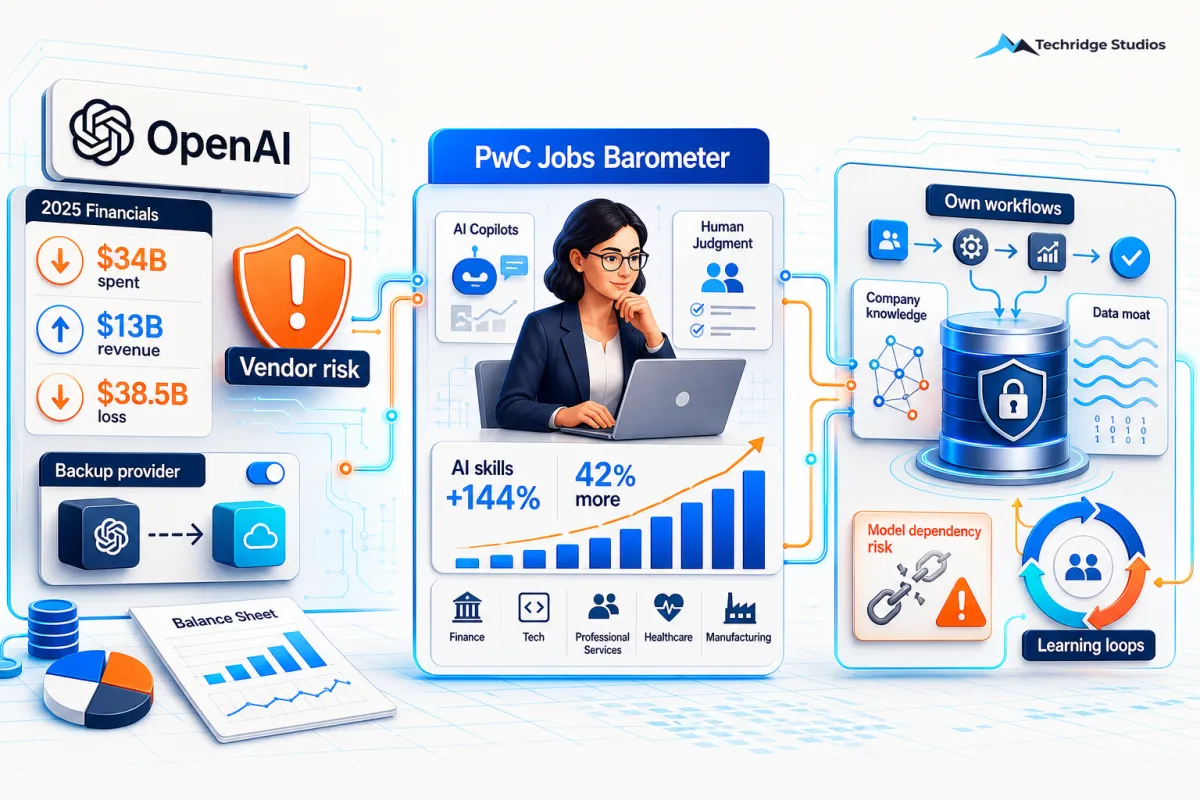
Audited 2025 financial documents from OpenAI — reviewed first by Ed Zitron's newsletter and independently verified by the Financial Times — show the company spent approximately $34 billion in 2025 while generating $13 billion in revenue. The net loss attributable to the company was $38.53 billion. That figure is inflated by a $41.55 billion one-time non-cash accounting charge from OpenAI's conversion from a nonprofit to a for-profit public benefit corporation in 2025, but even setting that charge aside, the company's operating losses expanded significantly year over year. Costs grew faster than revenue in every quarter of 2025.
The breakdown is striking: roughly $19 billion on research and development, nearly $6 billion on sales and marketing, and billions more on the Azure compute needed to serve ChatGPT at scale. OpenAI spent $5 billion on inference with Microsoft Azure in the first half of 2025 alone. The company ended the year with over $50 billion in assets, nearly half of which was in cash, backed by a $122 billion funding round closed earlier in 2026. It is not a company on the edge of collapse. But it is a company whose path to profitability depends heavily on AI agent products that have not yet proven their commercial scale at the volumes needed to close that gap.
OpenAI is preparing for a September 2026 IPO targeting a $1 trillion valuation. Revenue is growing fast — $13 billion in 2025, up from $3.7 billion in 2024. But the core economics are not yet sustainable: each new model requires more compute to train and to serve, and every quarter of 2025 saw costs accelerating ahead of revenue.
For small businesses that rely on ChatGPT, OpenAI's Codex, or any product built on the OpenAI API, this is a vendor risk conversation — not a panic. The company is well-funded and growing. But the standard practice of auditing your critical vendors applies here as much as it applies to your accountant, your payroll system, or your cloud storage provider. Which workflows in your business would break if OpenAI's API went down, changed pricing dramatically, or pivoted its product? That question is worth answering now, not later.
PwC Says the Best Hire in 2026 Pairs AI Tools With Human Judgment
PwC's 2026 Global AI Jobs Barometer, published June 15, analyzed more than one billion job postings across six continents. The finding is straightforward but important: AI is not uniformly replacing workers. It is sorting the labor market into two distinct tracks, and the track a role falls into determines the career trajectory of the person in it.
The first track covers what PwC calls "professionalized" roles — jobs where AI takes over the routine components and human expertise, judgment, and leadership become more central. Recruiters, analysts, advisors, strategists, and operators whose jobs now require working alongside AI tools rather than competing against them. These roles are seeing twice the job growth and 42 percent faster salary increases than average. The demand for specifically senior human capabilities — leadership, strategic thinking, contextual judgment — is showing up in entry-level job postings at seven times the historical rate as AI removes the routine runway that used to train those skills over time.
The second track covers "democratized" roles — positions where AI makes the work easier for less-experienced people, lowering the competitive premium on expertise. These roles still exist, but the salary and growth curves are flatter. Being very good at the task itself matters less when AI levels the playing field.
For a small business owner making hiring decisions in 2026, this research produces a specific filter. The most valuable new hire is not the person who lists the most AI tools on their resume. It is the person who can tell you what they do that the AI cannot — and demonstrate that the AI makes them faster and more productive, not the other way around. Ask candidates how they use AI in their work. Then ask what judgment calls they make that the AI gets wrong. That second question tells you who you are actually hiring.
Nadella Is Warning You About the Risk You Can't See Coming
Microsoft CEO Satya Nadella published an essay on X this week that has since circulated widely in business and technology communities. His warning is not about AI being unreliable. It is about AI being too reliable, in a way that could gradually strip away what makes a business distinctive.
Nadella's argument: if a small number of foundation models absorb the expertise, workflows, and institutional knowledge of entire industries, companies lose their competitive differentiation. They stop winning based on what they know and how they operate. They become interchangeable consumers of the same AI outputs. He compared the dynamic to globalization, which improved aggregate economic numbers while hollowing out the industrial base of entire regions. "The last thing any of us wants is a world where every company across every sector is ceding value to a few models that eat everything they see," he wrote.
For a small business, the risk is practical. If your customer service logic, your pricing strategy, your best process documentation, and your internal knowledge base all flow into a single AI platform — one whose terms of service you may not have read carefully — you are potentially building someone else's competitive advantage. Your interaction data trains their model. Your workflow logic informs their next product feature. And your dependency on that platform increases with every workflow you add to it.
The response Nadella is advocating does not require abandoning AI tools. It requires being thoughtful about where the learning loop lives. Document your processes in systems you own. Store your institutional knowledge in formats you can export and access independently. Use multiple AI providers rather than one. And treat your business logic and customer data as assets to be protected, not inputs to be donated to a platform in exchange for convenience.
What This Means for Your Business
These three stories converge on one theme: the AI vendor decisions you are making right now have longer-term consequences than they appear to. OpenAI's financials are a reminder that even the dominant AI provider has unresolved financial questions — and that depending on any single AI vendor for critical operations is a risk worth auditing. PwC's research shows that the advantage in 2026 goes to people who use AI well and still bring irreplaceable human judgment, not people who use AI the most. And Nadella's warning makes the case that the institutional knowledge you build through AI-assisted work should stay within your business, not flow entirely outward to the platforms that provide the AI.
The practical steps this week: review which of your workflows depend on a single AI provider and test one alternative. Update how you are capturing the institutional knowledge your team develops through AI-assisted work. And when evaluating new AI tools, add vendor financial health and data terms to your criteria alongside features and price.
Sources
Financial Times / Ed Zitron, Where's Your Ed At — https://www.ft.com/content/openai-spending-34-billion
PwC Global AI Jobs Barometer — https://www.prnewswire.com/news-releases/ai-reshapes-global-labour-market-into-two-distinct-paths-rewarding-human-skills-pwc-2026-global-ai-jobs-barometer-302798987.html