OpenAI Agents for Everyone, Anthropic's Payments Move, and Who's Actually Using AI Coding Tools
Three stories from this week reveal the same pattern: AI is moving off the platform's servers and into the daily operations of ordinary businesses — and the companies building these tools are starting to manage the infrastructure that comes with it.
OpenAI Is About to Make AI Agents Accessible to Everyone
For most of 2026, running an AI agent in production meant either hiring a developer or stitching together a workflow with third-party automation tools. That is about to change.
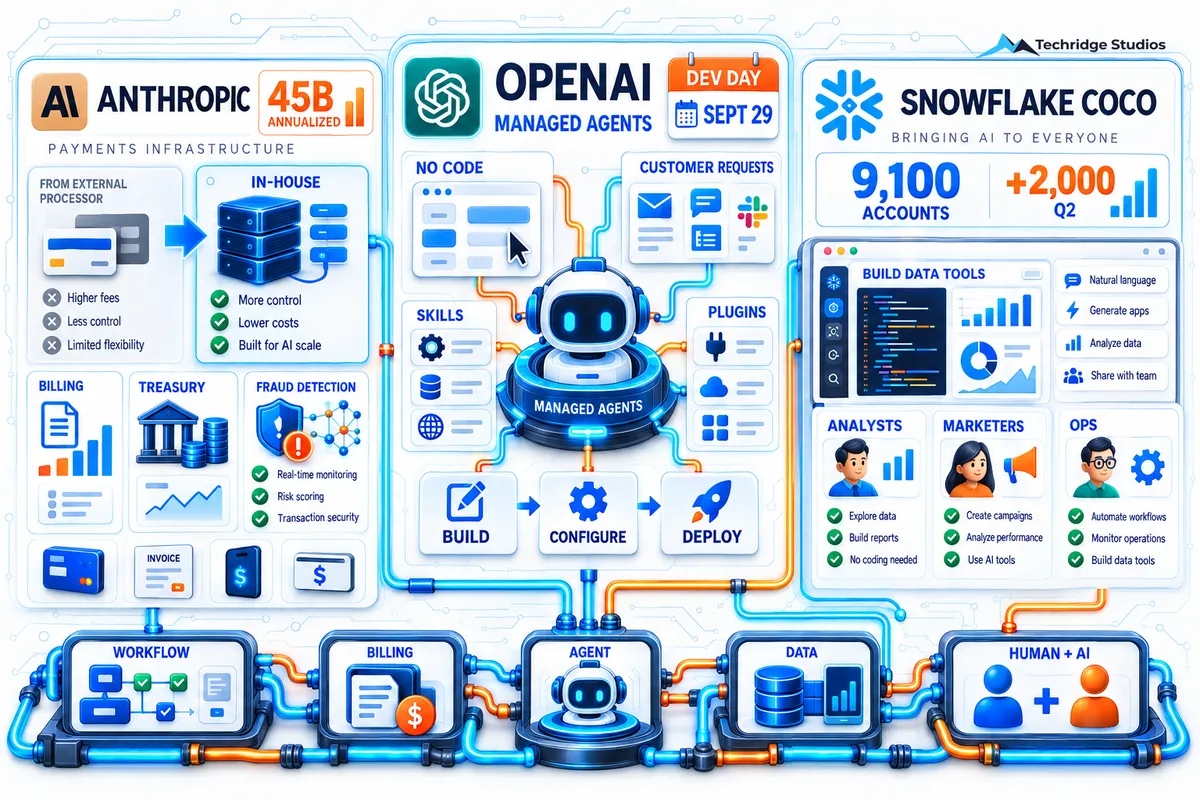
OpenAI is preparing to launch Managed Agents at DevDay 2026, its annual developer conference scheduled for September 29th in San Francisco. According to Testing Catalog, the platform will allow any user — not just developers — to create agents, configure environments, add skills and plugins, and deploy them directly inside the OpenAI platform. Self-hosting options are also reportedly planned.
This matters because it collapses a significant barrier to entry. Building an AI agent today still requires understanding how to connect APIs, manage session state, and handle errors gracefully. The Managed Agents platform is designed to handle that infrastructure for you.
For a small business, the practical implication is direct: if you currently use ChatGPT to answer questions, you may soon be able to build a lightweight agent that monitors your inbox, summarizes customer requests, drafts responses, and routes tickets — all without writing a single line of code.
The September 29th event is worth following closely. If the launch delivers what has been previewed, it may be the most consequential thing OpenAI ships this year for businesses that aren't engineering-led.
Anthropic Is Building Its Own Billing Infrastructure
Anthropic, the company behind Claude, is evaluating whether to replace its current Stripe integration with its own proprietary billing and payment tools. Crypto Briefing reports that Anthropic has posted engineering jobs seeking developers to build internal billing, treasury, and fraud detection systems.
An Anthropic spokesperson told The Information that "Stripe has been a strong partner to Anthropic for years, and we continue to work with them across our business." That said, the job postings are real, and the scale of the company makes the move logical.
Anthropic's annualized revenue has climbed toward 45 billion dollars in 2026. At that scale, the economics of a third-party payments processor make the build-versus-buy decision a genuine one. It also signals that Anthropic expects the transactional complexity of AI agent billing — usage-based, session-based, metered, and tiered — to require infrastructure built specifically for those models.
For small businesses, the short-term impact is minimal. But the longer-term signal matters: as AI platforms grow, the billing, pricing, and payment architectures they use will shape what plans look like, how usage is tracked, and what options are available for budgeting AI costs. Watch for any changes to Claude's pricing pages in the coming months.
Snowflake CoCo Is Growing Fast — and Non-Technical Users Are the Reason
Snowflake's Q2 2026 earnings, released on September 2nd, included a notable data point: CoCo, the company's AI coding agent, added over 2,000 net new accounts in a single quarter, bringing total users past 9,100. Management credited AI products for roughly half of the company's revenue acceleration, which reached 37 percent year-over-year product revenue growth.
More telling than the raw numbers is who is using it. CEO Sridhar Ramaswamy described CoCo as among the "easiest sales" Snowflake has made to its customer base. The reason: non-traditional builders — data analysts, marketers, and operations managers — are adopting it alongside developers. CoCo runs in a browser-based version inside Snowflake's analytics dashboard, removing the need for any local setup.
For small businesses, this is the clearest signal yet that AI coding tools are no longer just for engineers. If your business runs on data in any capacity, tools like CoCo represent a near-term opportunity for team members who understand the business logic but have never touched code to start building the automations they've always needed someone else to build for them.
The growth rate suggests this is not a niche trend. Adding 2,000 accounts in a single quarter is an adoption signal worth taking seriously.
What This Means for Your Business
All three stories point to the same inflection: the tools for running AI in production are getting simpler, faster, and more accessible to people who aren't developers. OpenAI's managed agent platform, Anthropic's infrastructure investment, and Snowflake's CoCo adoption curve are each signals that the 2026 AI story is no longer about whether AI can do the task — it's about whether the people running businesses can get access to it without needing a technical team.
The action step is straightforward: mark September 29th on your calendar and watch what OpenAI announces at DevDay. If Managed Agents launch as previewed, that is a practical tool you can evaluate for your workflows within days of the announcement.