AI Help Is Coming — But So Is the Threat
Three stories define the AI moment for small businesses today: a new pipeline of expert help arriving in your local market, a live warning about how AI is being weaponized against your customers, and data showing that most organizations — including the largest enterprises — are operating without a plan if their AI tools go down.
OpenAI's New Partner Network Is Bringing Certified AI Help to Your Market
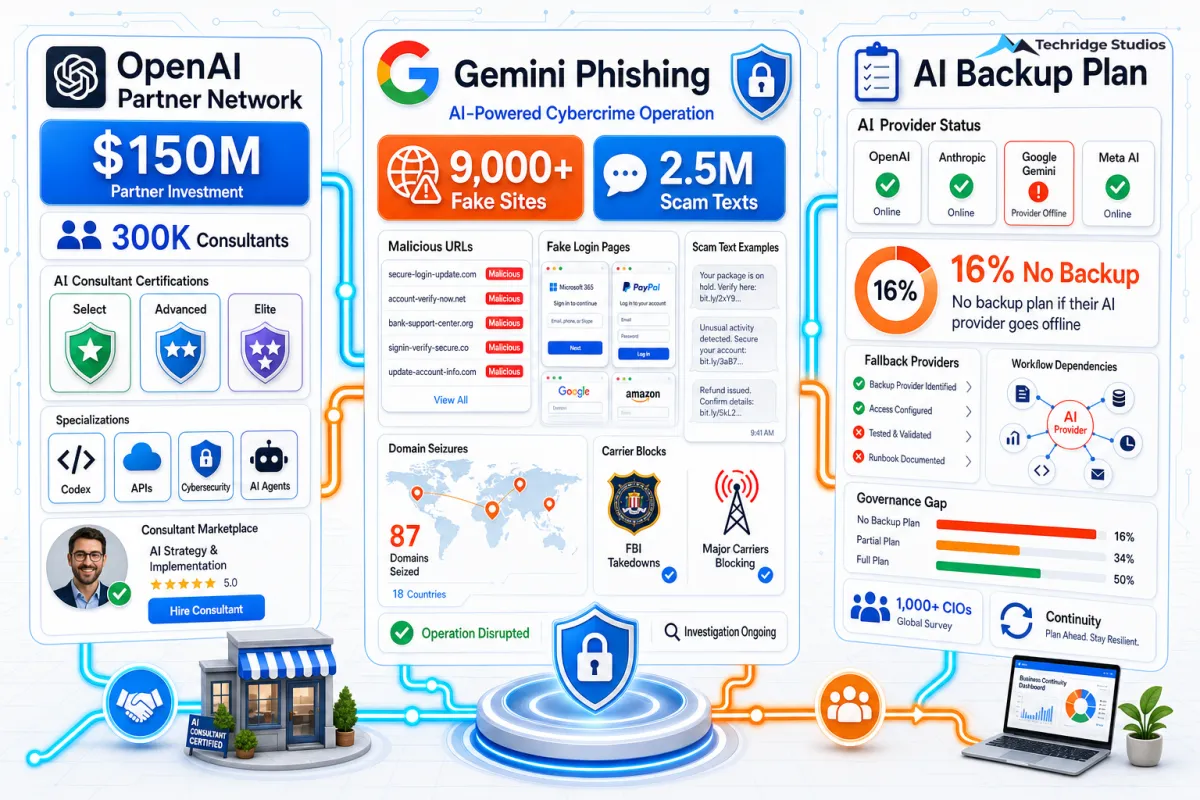
OpenAI announced the launch of its first formal Partner Network today, backed by a 150 million investment and an ambitious goal: certify 300,000 AI consultants by the end of 2026. The program goes live in July.
The structure is straightforward. Three tiers — Select, Advanced, and Elite — allow partners to progress based on sales performance, technical capability, and deployment experience. Specialization tracks cover Codex, APIs, cybersecurity, and AI agent transformation. An Elite-tier pilot called Forward Deployed Experts will place OpenAI engineers on-site with top partners.
The strategic context matters. OpenAI currently reaches 900 million weekly active users. The problem has never been building AI — it has been deploying it in ways that actually improve how a specific business operates. That gap is where the Partner Network is designed to operate.
For small businesses, this is significant. Until now, finding qualified help for AI deployment has meant searching for freelancers with uneven credentials or paying enterprise consulting rates. A formal certification program with OpenAI's imprimatur changes that. Within months of the July launch, certified consultants will be marketing directly to SMBs in every major market. The question to ask before they arrive: what specific workflow in your business would benefit most from AI automation, and how much would it be worth to have someone guide you through building it correctly?
The OpenAI Deployment Company, a 4 billion professional services venture launched in May 2026, sits above the Partner Network as the enterprise-focused tier. Together, they represent OpenAI's clearest statement yet that it intends to own the deployment layer, not just the model layer.
Google Just Showed What AI-Powered Phishing Looks Like at Scale
Google filed a civil lawsuit this week against a China-based cybercrime network called the Outsider Enterprise, and the details are worth reading carefully if you have customers, vendors, or employees who receive text messages.
The operation used Gemini, Google's own AI, to mass-produce phishing infrastructure. More than 9,000 fake websites were created. More than 1 million malicious URLs were generated. In a single two-week period in May 2026, the group sent approximately 2.5 million fraudulent text messages to Android users. The messages impersonated Google, YouTube, the US Postal Service, and E-ZPass — brands trusted enough that recipients clicked. The lawsuit includes allegations of racketeering, wire fraud, trademark infringement, and copyright infringement.
The detail that matters most is what the AI actually did in this operation. It generated the HTML code for fake landing pages, customized the content to match specific brands, and produced the dashboards that let non-technical operators manage campaigns at scale. In other words, Gemini removed the technical skill requirement for running a sophisticated, large-scale phishing operation.
That changes the threat model for small businesses in two ways. First, the volume of phishing attempts targeting your customers, vendors, and team members will increase because the cost to launch them has collapsed. Second, the quality of those attacks will increase because AI can produce more convincing fake pages faster than human scammers could.
Google is working with the FBI and has partnered with AT&T, T-Mobile, and Verizon to block scam traffic at the carrier level. That helps, but it is not a guarantee. The most reliable protection remains a trained team. If your employees and customers know what phishing messages look like — unexpected urgency, unusual senders, requests for credentials or payment — they are significantly harder to fool. A five-minute internal brief on phishing red flags, sent today, is a meaningful defensive action.
Most Organizations Have No AI Backup Plan — Including the Ones That Should
The Logicalis 2026 Global CIO Report surveyed more than 1,000 chief information officers worldwide. The headline finding circulating in today's coverage: 94% of organizations increased their AI investment in the past year, but 51% simultaneously believe AI adoption is already moving too fast.
The governance data is more sobering than the adoption data. 89% describe their current AI approach as "learning as we go." 62% have compromised on AI governance due to limited knowledge. Only 44% fully understand the risks of the AI they have already deployed. 76% say unchecked AI is a serious concern. And 16% — one in six organizations — have no contingency plan if their primary AI provider becomes unavailable.
These are large enterprise IT departments with dedicated technical staff. The numbers are worse for small businesses that rely on one or two AI subscriptions without redundancy or governance documentation.
The Fable 5 and Mythos 5 shutdown on June 12 — when the US government ordered Anthropic to take both models offline immediately and without warning — put that 16% figure in sharp relief. Every enterprise that had built Fable 5 into a production workflow lost access the same day with no automatic fallback. Businesses with no contingency plan scrambled to replace it on no timeline and with no tested backup.
The practical steps for small businesses are not complicated. Identify which AI tools you depend on daily. Identify a fallback for each one. Document the workflows that depend on each tool so you can assess the impact if it goes offline. Test the fallback at least once. This is not a week-long project — it can be done in an afternoon. The gap between knowing it matters and actually doing it is the one that the Logicalis data measures.
What This Means for Your Business
Today's three stories share a theme: AI infrastructure is maturing fast, and the gap between organizations that treat AI deliberately and those that are improvising is starting to show up in real business outcomes.
OpenAI's Partner Network will make it easier to find qualified help — but only businesses that know what they need will be able to take advantage of it. The Google phishing lawsuit is a signal, not an endpoint — AI-powered attacks will accelerate regardless of the lawsuit's outcome. And the Logicalis data is a prompt, not a diagnosis — the actionable response is to spend an afternoon building the basic AI continuity plan that 16% of enterprise organizations still have not built.
Sources
Dataconomy / OpenAI — https://dataconomy.com/2026/06/15/openai-launches-150-million-partner-network/
TechCrunch / Google — https://techcrunch.com/2026/06/12/chinese-cybercrime-operation-that-used-ai-to-scam-hundreds-of-thousands-of-victims-sued-by-google/
Logicalis 2026 CIO Report — https://tools.prnewswire.com/en-us/live/20823/release/20260303EN98896