You're Paying for AI Twice — and Most Small Businesses Don't Know It
Three AI developments from this week point to the same uncomfortable truth: access to AI tools is not the same as using them well, and the gap is getting more expensive to ignore.
Satya Nadella's Warning: Your AI Prompts May Be Your Biggest Business Risk
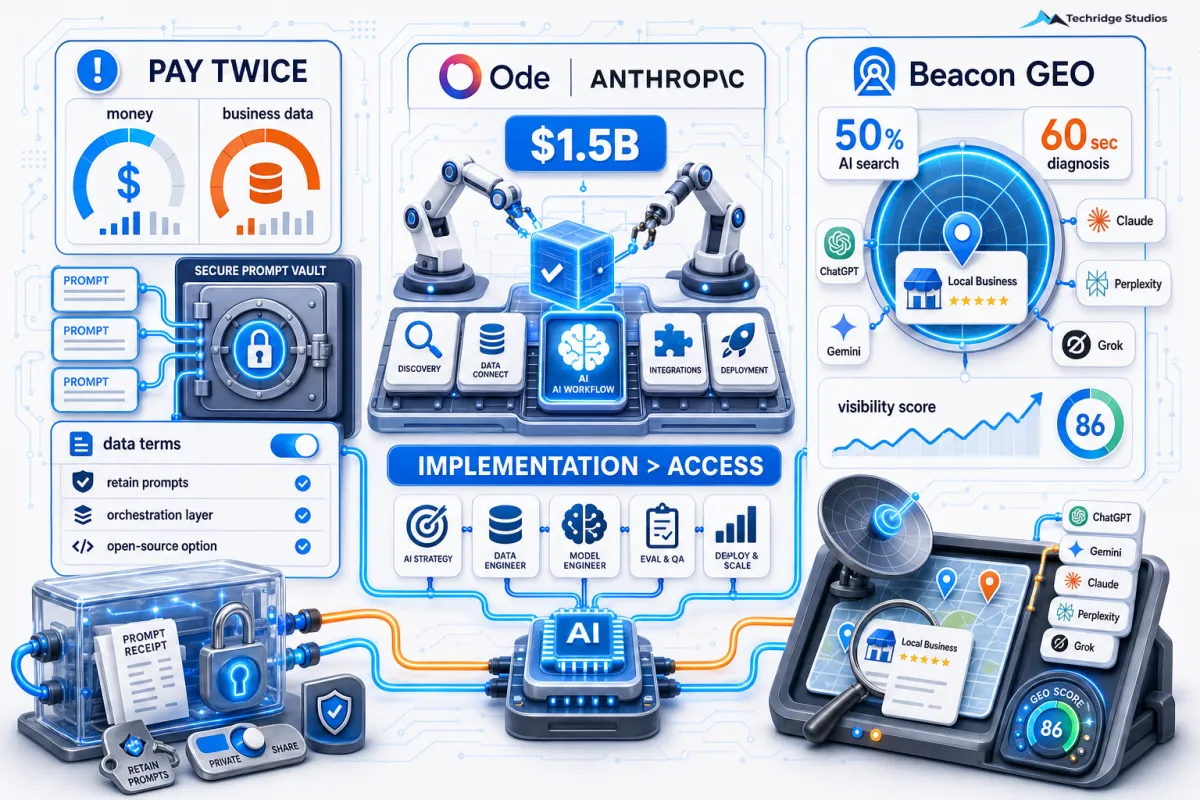
In a blog post published Sunday, Microsoft CEO Satya Nadella made an argument that should be required reading for every business owner using AI tools. His thesis is straightforward and unsettling: when you use AI, you pay twice. You pay first with money — subscriptions, API costs, and usage fees. You pay second with something more valuable: the proprietary business knowledge embedded in every prompt you send.
"The better you want the model to perform, the more of that knowledge you have to feed it," Nadella writes. AI models learn from what he calls "exhaust" — the prompts users write, the tools agents use, and especially the corrections people make when the model is wrong. Each correction, each iteration, each custom workflow represents institutional knowledge about your business. Under many providers' terms of service, that knowledge may be used to improve the model itself.
This is not a hypothetical concern. Nadella specifically flags AI providers that "reserve the right to learn from customer usage and interaction data." He argues this creates an asymmetric relationship: businesses hand over their most sensitive operational knowledge in exchange for AI assistance, while the provider accumulates a deeper understanding of every industry it serves. The CEO of the company that owns LinkedIn, Azure, and a major stake in OpenAI is now publicly urging businesses to be cautious about proprietary AI models. That is not a subtle warning.
For small businesses, the action is concrete. Review your AI provider's data usage terms this week — specifically, whether your prompts or interaction history are used for model training. If they are, check whether a privacy mode, an on-premise open-source alternative, or a multi-model routing tool gives you more control. Enterprise tools like AI gateways, which let teams switch between models without lock-in, are becoming accessible for smaller operations. The principle Nadella argues for — that what you create using AI should belong to you — is one every business owner should internalize before their workflows become someone else's training data.
Ode with Anthropic: AI Implementation Is Now Its Own Market
For the past two years, the dominant AI narrative has been about model capability — which model scores highest on benchmarks, which one reasons more accurately. On July 15, 2026, a 1.5 billion dollar company launched with an entirely different thesis: the hard part is not which model you use. It is getting AI to actually work inside your business.
Ode, backed by Anthropic, Blackstone, Hellman & Friedman, Goldman Sachs, Sequoia Capital, and others, is a standalone AI implementation company. It employs 100 engineers and deploys them directly to client organizations to design, build, and integrate AI systems tailored to each business's operations. The company was built on Fractional AI, an applied AI services firm that Anthropic acquired in May 2026. It operates under a "Claude-first" principle but will use other AI products when the use case calls for it.
The reason a company like this can raise 1.5 billion dollars is that the implementation gap is real. Most businesses that invest in AI tools do not fully deploy them. They experiment, run pilots, and then stall — blocked by a lack of internal expertise, unclear return on investment, or difficulty connecting AI tools to existing systems. That is exactly the pattern documented in the Pax8 Q2 SMB AI Pulse Report last week: one in three AI-using businesses is stuck in experimentation and cannot advance to deployment.
Ode itself targets large enterprises today. But its launch matters to the SMB market for one structural reason: when firms like Blackstone commit capital to the implementation layer, it pulls talent, playbooks, and tooling toward that category. The structured AI deployment services that cost $ 2,500 to $ 5,000 per month from an agency today will be available at a fraction of that cost within 12 to 18 months as the market matures. If your business is still testing AI rather than running it in core workflows, this week is a good time to define what "deployed" looks like for a specific process — and to start treating implementation as a budget line, not a side project.
Beacon: The New Battleground Is AI Search, Not Google Search
For the past decade, small business visibility meant one thing: ranking on Google. Search engine optimization, Google Business Profiles, and backlink strategies all converged on the same goal — getting to the top of a results page. That playbook is becoming obsolete faster than most business owners realize.
Avalon GloboCare announced on July 15, 2026, that it will launch Beacon, a subscription-based Agentic Generative Engine Optimization (GEO) platform designed specifically for small businesses. Beacon will analyze a business's visibility across ChatGPT, Gemini, Claude, Perplexity, and Grok — the five AI-powered search and discovery engines now in daily use by consumers — and generate implementation-ready recommendations to improve that presence. The initial AI visibility diagnostic is designed to be completed in approximately 60 seconds.
The platform responds to data that should alarm any business relying on website traffic for growth. McKinsey research cited in the announcement found that approximately 50 percent of consumers now use AI-powered search to make purchasing decisions. Nearly 60 percent of all searches that trigger an AI response end without the user clicking through to any website. The buyer found what they were looking for inside the AI's answer. If your business is not cited in that answer, you were not considered.
This is not a future problem. The shift is happening now, and the businesses that have already built authority inside AI search engines — through structured data, consistent brand signals, clear factual content, and citation-worthy information — are the ones appearing in AI recommendations today. Beacon is designed to make this process systematic for small businesses that cannot figure it out manually. Whether or not Beacon is the right tool for your operation, the underlying question it addresses is one you should be asking this week: when a potential customer asks an AI to recommend a business like yours, do you appear?
What This Means for Your Business
Three stories from the past 72 hours, three different angles — but the same message. The businesses getting ahead in AI are not just paying for subscriptions. They are protecting the data they give up, building structured systems to deploy AI inside their operations, and expanding their definition of visibility to include AI-powered search alongside Google.
The most actionable thing you can do today: open ChatGPT, Gemini, or Perplexity and search for the product or service you sell in your city. Note whether your business appears. If it does not, you have a concrete starting point for this week's AI work. If it does, you are ahead of most of your competitors — and the tools arriving in Q3 2026 will help you stay there.
Sources
TechCrunch — https://techcrunch.com/2026/07/13/satya-nadella-has-issued-a-shocking-warning-to-companies-using-ai/