Rust Cracks Down on AI Code as Courts Clear AI Shopping Agents
Three stories broke this week that show AI oversight tightening from three different directions: who gets to write code, who gets to shop for you, and who checks AI for compliance before it ships. Here is what changed and what it means if you run a small business.
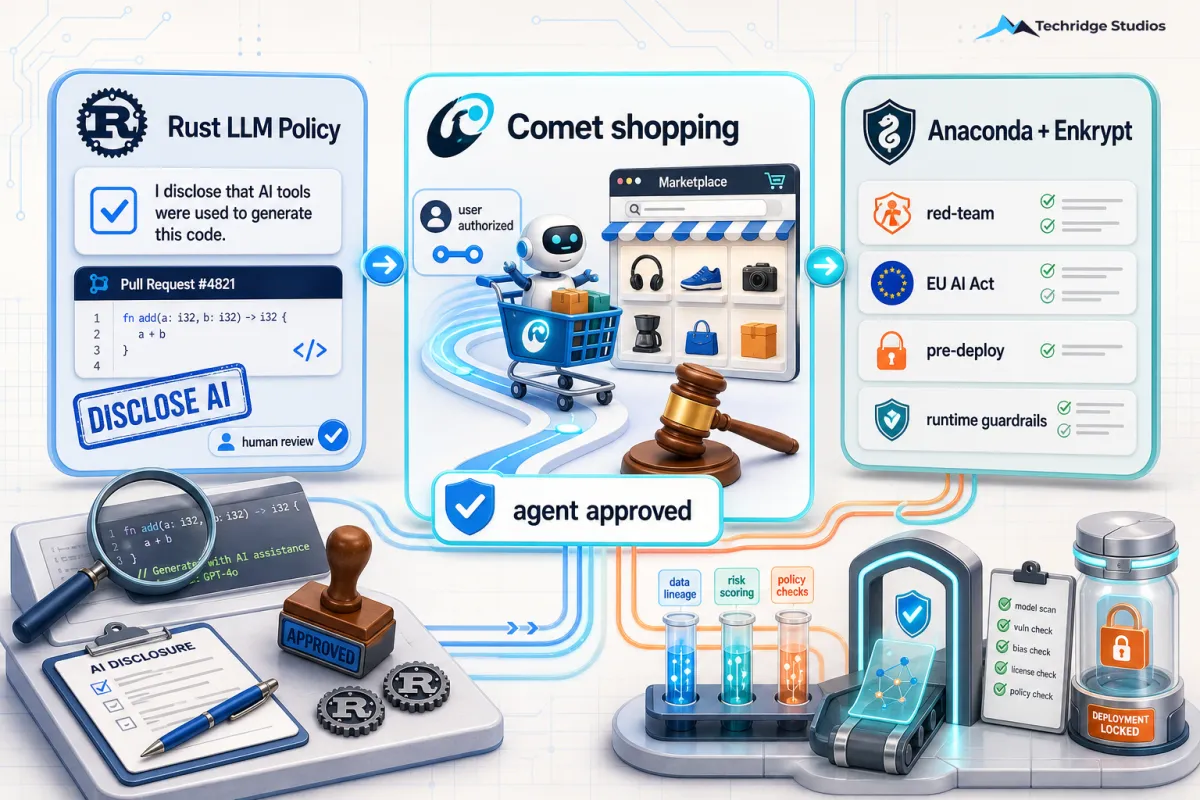
Rust Now Requires Contributors to Disclose AI-Written Code
The Rust programming language's core maintainers published a formal policy this week distinguishing between private use of AI tools and public contributions. Under the new rules, comments, pull requests, and issue bodies created by an LLM must be disclosed, and reviewers can close non-compliant submissions without further explanation. The policy was driven by a rising tide of what the community calls "slop" contributions — low-effort, AI-generated pull requests that cost maintainers more time to review than they save.
This matters even if your business has never touched an open-source project. It is an early, concrete example of a large technical community setting hard rules for how AI-generated work gets reviewed and disclosed. If your team uses AI coding tools, whether that is Copilot, Cursor, or an in-house agent, this is a good moment to write down your own version of that policy: who reviews AI-generated code before it ships, and how you track what was AI-assisted versus AI-generated.
Small businesses that build or maintain their own software, even a simple website or internal tool, should treat this as a preview of where client expectations and vendor contracts are headed.
Courts Clear Perplexity's AI Shopping Agent to Browse Amazon
The Ninth Circuit Court of Appeals vacated a lower court's injunction that had blocked Perplexity's Comet AI shopping agent from operating on Amazon. Amazon had argued that Perplexity's agent violated federal computer-hacking law by accessing its servers without authorization. The appeals court disagreed, ruling that it is the user, not Perplexity, who is doing the "accessing" when they direct an AI agent to shop on their behalf.
The ruling is narrow and the underlying case continues, but it is the first real appellate test of whether AI shopping agents can legally act on a customer's behalf on a retailer's site. For small businesses that sell through Amazon or their own online store, this points toward a near future where AI agents, not just human shoppers, are browsing your product pages and deciding what to buy.
The practical takeaway: product titles, descriptions, and structured data need to be clear enough for an AI to parse correctly, not just persuasive to a human reader. If your listings depend on tone, imagery, or context a human would pick up on, an AI shopping agent may miss it entirely.
AI Security and Compliance Checks Are Going Built-In
Anaconda announced it has acquired AI security startup Enkrypt AI, folding pre-deployment red-teaming, runtime guardrails, and compliance automation for frameworks like the EU AI Act directly into the Anaconda Platform. Instead of buying a separate compliance tool, businesses building on Anaconda now get those checks as part of the platform itself.
This is part of a broader pattern: AI security and compliance are moving from bolt-on products toward built-in features of the tools businesses already use. For a small business, that is good news. It means access to enterprise-grade AI governance without hiring a dedicated compliance team, as long as your software vendors follow Anaconda's lead and bundle these checks into their own platforms.
What This Means for Your Business
None of these three stories requires an immediate purchase or policy change, but together they point to the same direction: AI-generated work, AI-driven shopping, and AI compliance are all getting more structured and more scrutinized. The single next action worth taking this week is auditing one thing: where AI touches your business today, whether that is code, customer-facing content, or a workflow tool, and whether a human is reviewing it before it goes live.
Sources
Inside Rust Blog — https://blog.rust-lang.org/inside-rust/2026/08/05/rust-langrust-is-adopting-an-llm-policy/
Dataconomy — https://dataconomy.com/2026/08/05/perplexity-amazon-injunction-court-ruling/
Anaconda — https://www.anaconda.com/blog/anaconda-acquires-enkrypt-ai