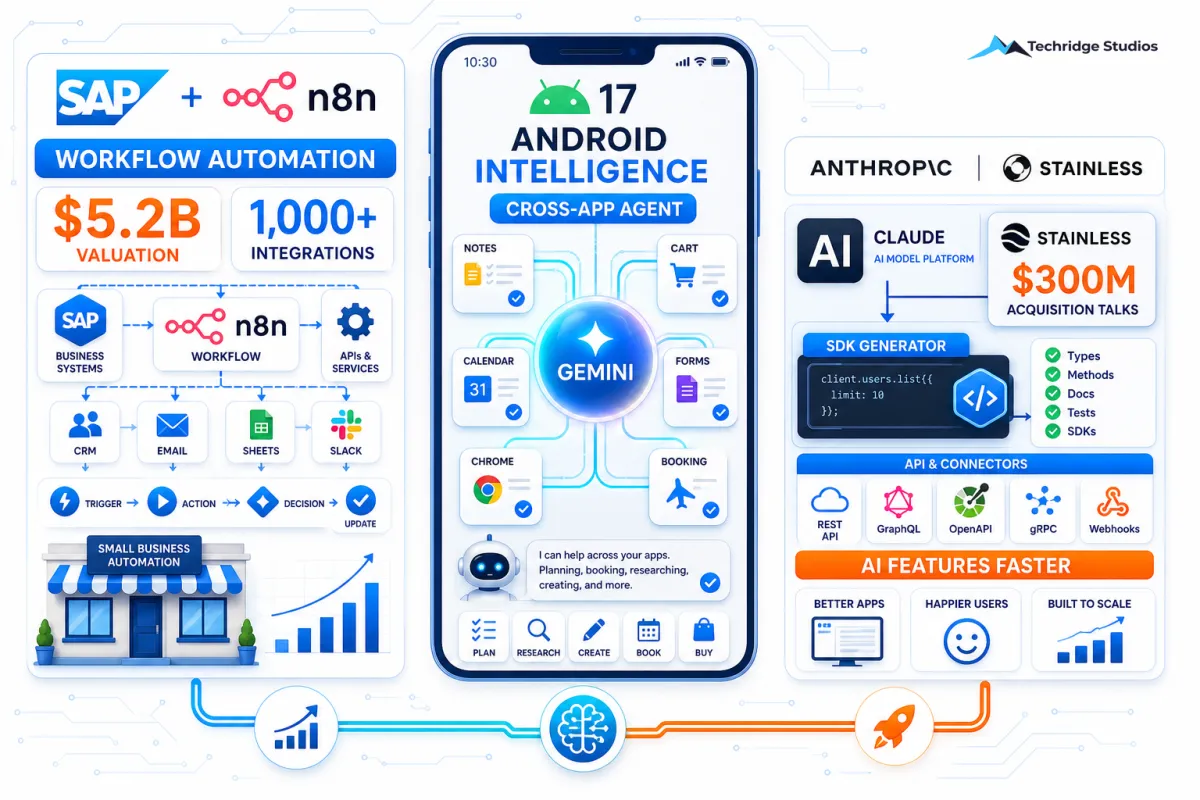
SAP, Google, and Anthropic Just Changed the Playing Field
Three announcements this week reveal that AI infrastructure — the layer beneath the tools — is being locked in fast. The companies that control the workflow layer, the mobile OS layer, and the developer tools layer are making billion-dollar moves. For small businesses, the window to build AI-native operations before competitors do is narrowing.
SAP Backs n8n at 5.2 Billion Dollars — Workflow Automation Is Now Core Business Infrastructure
SAP, one of the largest enterprise software companies in the world, made a strategic investment in n8n — a workflow automation platform — on May 12th, 2026, doubling the startup's valuation from 2.5 billion dollars to 5.2 billion dollars in under a year. SAP is not just investing. It is embedding n8n directly into Joule Studio, its own agent-building environment in SAP Business AI Platform, with over 1,000 integrations connecting SAP systems to every tool an organization uses.
The business implication runs deeper than the deal itself. n8n already has 1.7 million monthly active developers and builders — including tens of thousands of small business operators who use it to connect CRMs, email platforms, spreadsheets, Slack, and other daily tools without writing code. The fact that SAP — a company whose products serve the Fortune 500 — made workflow automation its centerpiece signals that this layer is no longer a nice-to-have. It is becoming required business infrastructure.
For small businesses, the opportunity is real and immediate. You do not need an SAP relationship to use n8n. The platform is available today, free to start, with paid tiers for production workloads. The most common entry points: connecting your CRM to your inbox so new leads trigger an automated response sequence, syncing form submissions to a spreadsheet and a Slack notification simultaneously, or routing customer service requests to the right team member based on keywords.
The businesses setting up even two or three of these connections today are building a compounding advantage. Every manual task removed means time redirected to higher-value work. SAP just confirmed that the market values this compounding at 5.2 billion dollars.
Google Rebuilds Android Around Gemini Intelligence — Your Customers' Phones Are Becoming AI Agents
On May 12th, 2026, Google held its Android Show event — a preview of Android 17 and a broader vision for where mobile computing is headed. The headline: Android is no longer just an operating system. It is becoming what Google calls an "intelligence system" powered by Gemini Intelligence.
Gemini Intelligence is an AI agent built into the core of Android. It can move across apps, understand what is on the screen, and complete tasks that would normally require a user to jump between multiple services. Book a class. Build a shopping cart from a list in the notes app. Fill out a form using information from the user's calendar and emails. Respond to a message using context from their inbox. All of this without the user manually navigating each app.
Sameer Samat, who oversees Google's Android ecosystem, told CNBC plainly: "We're transitioning from an operating system to an intelligence system."
The rollout begins on select Samsung and Google devices this summer, with broader availability later this year. Google's annual developer conference on May 19th is expected to expand on these features significantly.
For small businesses, this is not abstract. When customers start using Gemini Intelligence to handle daily tasks, the way they find, evaluate, and purchase from businesses changes. A customer may ask their phone to book them a haircut, find a local plumber with good reviews, or order their usual supplies — and the AI agent will handle the discovery, comparison, and transaction. If your business is not visible and accessible through AI-mediated interfaces, you risk being skipped entirely.
The practical action now: make sure your business listings are accurate and complete on Google Business Profile. Ensure your website loads cleanly and contains the right information in plain, machine-readable language. These are the signals AI agents use when making decisions on behalf of customers.
Anthropic in Talks to Acquire Stainless — A 300 Million Dollar Bet on the Layer That Builds AI Tools
On May 13th, 2026, The Information reported that Anthropic is in advanced talks to acquire Stainless — a four-year-old developer tools startup based in New York — for at least 300 million dollars. Stainless builds software that uses AI to automatically generate software development kits, the code libraries developers use to integrate AI APIs into their applications. Its clients include OpenAI, Google, and Anthropic itself.
The deal would mark Anthropic's fourth significant acquisition in six months, following Bun (a JavaScript runtime), Vercept (a computer use startup), and Coefficient Bio (AI biotech). The pattern is deliberate: Anthropic is not just building a model. It is building the full developer ecosystem around Claude — the runtime, the integrations, the security layer, and now the SDK generator that makes it faster for any software company to add Claude to its product.
For small businesses, the connection requires one step to see — but it is worth understanding. Every tool you use daily, from your email platform to your project management app to your accounting software, was built by developers who had to integrate APIs to add AI features. The slower and harder that integration is, the fewer tools add AI, the later they add it, and the more basic the implementation tends to be. Stainless makes that integration faster and more accurate.
By acquiring Stainless, Anthropic is reducing the friction for any developer to embed Claude. The downstream effect for small businesses: the apps you already use will gain Claude-powered capabilities sooner, with less time in development and more reliability in production. You will not need to switch tools. The tools will come to you.
What This Means for Your Business
Three moves happened this week — and they each point to the same underlying shift. AI infrastructure is being locked in at the platform level. The companies that control the workflow layer, the mobile OS layer, and the developer tools layer are betting billions that these are the chokepoints of the next decade of business software.
For a small business owner, the strategic imperative is not to wait for this to stabilize. It never will. The practical action today is to pick one: set up one automated workflow connecting two tools you use daily, audit your Google Business Profile for accuracy and completeness, or ask your software vendors what AI features are on their roadmap and when they ship. Start with one. That is enough.
Sources
The Information — https://www.theinformation.com/articles/anthropic-talks-buy-developer-tools-startup-used-openai-google