AI Protocol Upgrade, Free Security Tools, and the Bot Takeover: What It Means for Your Business
The biggest open standard for AI agents just shipped a security overhaul. A coalition of 37 tech giants launched free AI security tools for any business to use. And bots have officially outnumbered humans in internet traffic. Three stories from July 29th, 2026 — all pointing at the same question: how secure and accurate is the data running your business right now?
The AI Protocol Running Your Business Tools Just Got a Major Upgrade
The Model Context Protocol — commonly referred to as MCP — is the open standard that connects AI agents to your business software. Think of it as the connector layer between an AI assistant and the tools it needs to do its job: your inbox, your CRM, your file system, your project management platform. Without MCP, AI agents would have no standardized way to reach into your software and take action.
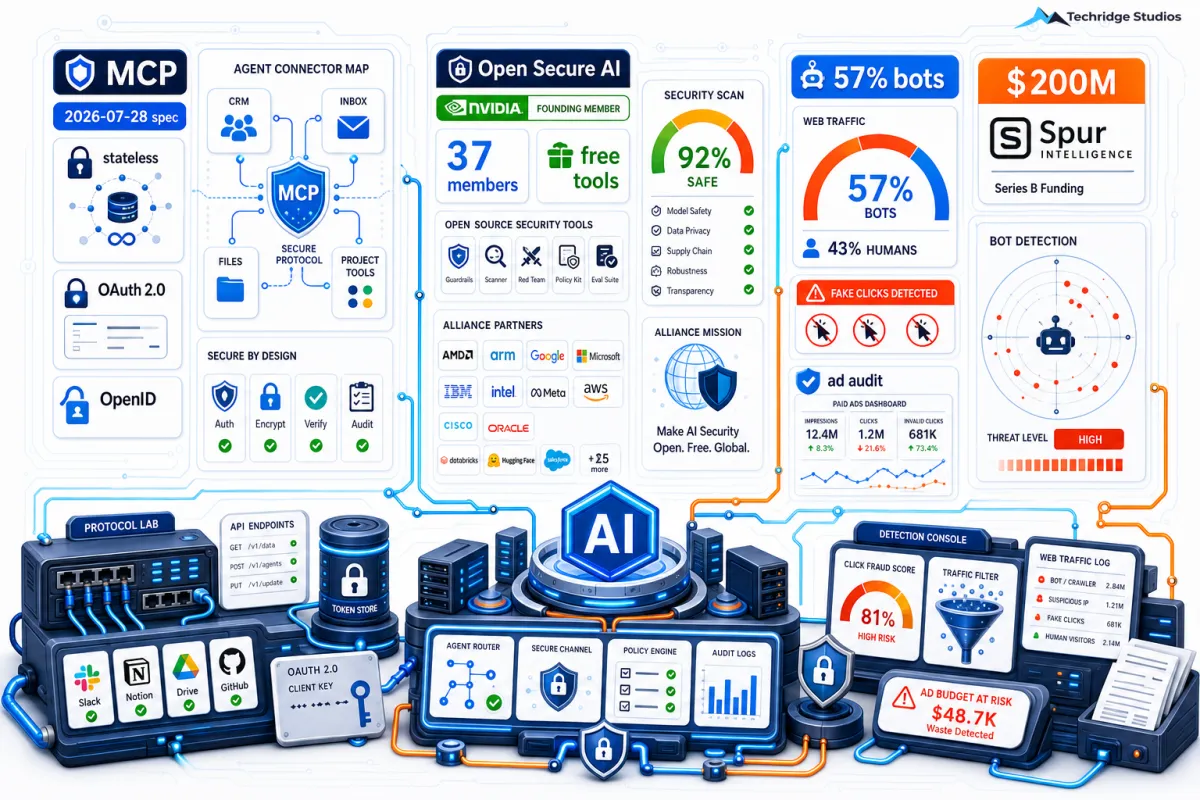
On July 28th, 2026, the Agentic AI Foundation — a Linux Foundation-directed fund — shipped the 2026-07-28 specification, the largest revision to MCP since Anthropic first released it roughly 20 months ago. VentureBeat called it the change that "finally makes agentic AI ready for massive enterprise production deployments." The Tier 1 software development kits for the protocol are seeing nearly half a billion downloads per month — meaning this update is going out to a vast number of tools and systems at once.
Three changes stand out for business operators. First, the protocol is now stateless. The old session handshake is gone, and every AI agent request carries its own context. This eliminates a class of vulnerabilities tied to persistent session state and makes agents faster. Second, authentication received a full overhaul and is now tightly aligned with OAuth 2.0 and OpenID Connect — the same standards that protect your bank account and email login. Third, a formal extensions framework was added, giving developers a governed, predictable way to expand the protocol without breaking the core behavior.
For small businesses, the practical impact is this: if you use any AI tool that connects to your data — an AI email assistant, a smart project management plugin, a chatbot that pulls from your documents — it is now running on a more secure and reliable foundation. You do not need to do anything today. But if you are evaluating AI workflow tools in the next 90 days, ask your vendor one question: have you updated your MCP implementation to the 2026-07-28 specification?
37 Tech Giants Just Pledged Free AI Security Tools for Every Business
On July 27th, 2026, Nvidia led the launch of the Open Secure AI Alliance — a 37-member industry coalition with a single stated goal: build free, open-source AI security tools for any organization, regardless of size or budget.
The founding members include Nvidia, Microsoft, IBM, Cisco, Cloudflare, Salesforce, Hugging Face, Databricks, Palantir, SAP, Siemens, and the Linux Foundation. The alliance builds on existing open-source security work from the Open Source Security Foundation and is launching in direct response to the wave of AI security incidents that have hit the industry over the past several weeks.
The coalition's stated approach is to build shared cyber-defense tooling — tools that identify vulnerabilities in AI infrastructure, patch them collaboratively, and disclose them responsibly so every organization benefits. Notably, the founding members include security companies such as Cisco, CrowdStrike, and Palo Alto Networks, as well as AI platform companies, signaling a strong commitment to cross-industry security cooperation.
For small businesses, this matters in a very concrete way. Professional AI security is currently expensive and largely inaccessible to SMBs. Most small businesses rely on the default security settings of the tools they purchase. The Open Secure AI Alliance is a direct signal that the industry is moving toward shared security infrastructure — tools that could let a five-person business audit its AI deployments with the same rigor a Fortune 500 company uses today.
Watch this coalition closely over the next 60 to 90 days. If they ship even half of what they are promising, it could become the most valuable free AI security resource available to small businesses.
Bots Now Outnumber Humans Online. Your Business Data May Not Reflect Reality.
Here is a number that should give every small business owner pause. As of mid-2026, more than 57 percent of all web traffic is now automated. Bots — not real people — make up the majority of activity on the internet. This is the first time in internet history that has been true, and it crossed the line faster than industry analysts predicted.
The market responded immediately. On July 28th, 2026, bot-detection startup Spur Intelligence raised $ 200 million from Insight Partners, marking one of the largest funding rounds in cybersecurity focused on bot defense. The investment is a clear signal: the scale of the bot problem is outpacing what existing tools can handle.
The practical problem for small businesses comes down to data integrity. If you run Google Ads, Meta Ads, or any kind of paid digital campaign, a portion of your clicks and impressions are likely coming from bots — not customers. The same applies to your website analytics. Session counts, bounce rates, time-on-page figures, and conversion funnels can all be artificially inflated by automated traffic with no intent to buy. When you make budget decisions based on that data, you may be optimizing for an audience that does not exist.
Here is a practical audit you can complete in under 30 minutes today. In Google Analytics, navigate to your audience report and filter for sessions under one second with zero page interactions — that spike is almost certainly bot traffic. In Google Ads, open the campaign statistics menu and pull the invalid click report. In Meta Ads, compare your reported cost-per-result against your actual sales revenue for the same period — a large and consistent gap often points to inflated traffic. Most major ad platforms have built-in bot filtering, but it is often disabled by default and requires manual activation.
What This Means for Your Business
These three stories share a thread. The infrastructure of AI is maturing, and security is now the central concern — not just capability. Agents are getting more secure through protocol updates. Industry coalitions are forming to democratize security tooling. But bot-driven data corruption is a real problem affecting businesses today.
Your single next action: run a bot traffic audit on your web analytics and paid ad accounts this week. It takes less than 30 minutes and may change how you allocate your ad budget next month.
Sources
VentureBeat — https://venturebeat.com/infrastructure/mcp-just-got-its-biggest-update-ever-heres-what-changes-for-ai-agents
The Hacker News — https://thehackernews.com/2026/07/nvidia-forms-37-member-open-secure-ai.html
TechCrunch — https://techcrunch.com/2026/07/28/bot-detection-startup-spur-nabs-200m-from-insight/