The Chatbot Trap, Calendar AI, and ChatGPT Ads for Any Budget
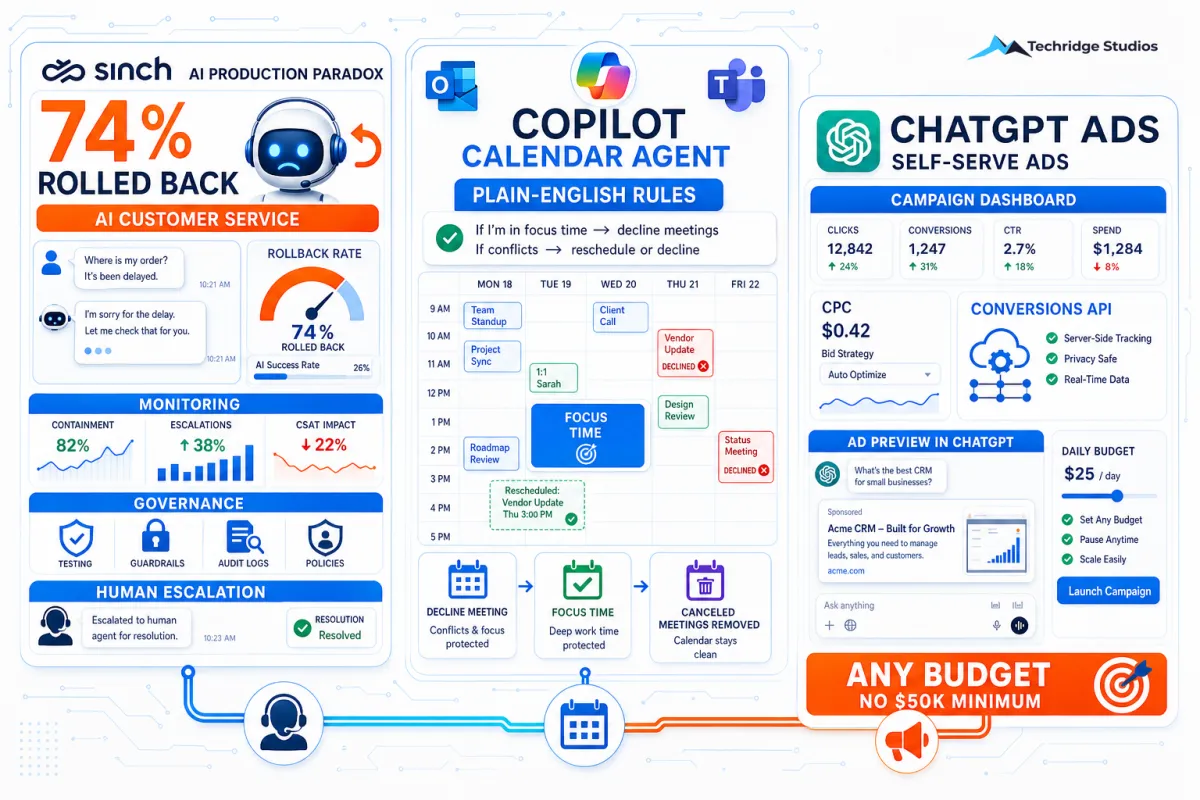
Three developments from this week all point toward the same uncomfortable truth: AI is not the hard part. The hard part is building the structure around it — the controls, the workflows, and the access channels — that make AI actually useful for your business.
Why 74 Percent of AI Chatbot Deployments Get Shut Down
A new study from communications platform Sinch breaks one of the biggest myths in enterprise AI right now: that getting AI into customer service is the hard part.
Sinch surveyed 2,527 senior decision-makers across ten countries between January and February 2026 — a dataset covering retail, financial services, healthcare, and professional services. Their finding: 74 percent of organizations that deployed a live AI customer communications agent have already rolled it back or shut it down. The research calls this "The AI Production Paradox" — the gap between how fast organizations are pushing AI into customer-facing roles and how quickly they walk it back when those systems behave unexpectedly.
What the rollbacks are not about is important. They are rarely about the AI breaking or producing false outputs in a catastrophic way. The agents perform the tasks they were configured for. The problem is performance drift — agents that perform accurately in testing begin producing inconsistent outputs in the real world, where conversational variables are unpredictable. Without active monitoring and human escalation paths, these failures go uncaught until a customer complains.
The study found a paradox within the paradox: organizations with the most mature governance frameworks had rollback rates of 81 percent, higher than the average. This seems counterintuitive until you understand why: mature governance means better monitoring. These companies catch problems faster because they actively watch for them. For small businesses considering an AI customer service deployment, the takeaway is direct. Before you go live, build the control layer. Document what the agent is supposed to do. Define what off-track behavior looks like. Set a human escalation threshold before launch, not after.
Microsoft's Calendar Agent Is the Simplest AI Time Saver Available Today
Most AI features in Microsoft 365 Copilot require you to open something, ask something, or actively engage with the tool. The new Calendar Agent is different. You write a rule once, in plain language, and then Copilot runs it in the background.
Calendar Agent launched in a limited preview on April 27, 2026, with a broader rollout expanding to Microsoft 365 Copilot subscribers through May. It runs inside Outlook on Windows, Outlook on the web, and Microsoft Teams. Instructions can be anything a calendar assistant would reasonably understand — block focus time automatically each morning, decline external meeting invites when I have fewer than two working hours left in my day, remove canceled meeting blocks from my schedule immediately, protect Friday afternoons for administrative work.
The design deliberately avoids traditional if-then rule builders. Instead of dropdown menus and conditional logic trees, you type what you want in natural language, and Copilot interprets the intent. This is meaningful for small business owners who are not IT administrators and don't have time to configure complex calendar automation tools. The setup takes minutes. The payoff is ongoing.
Microsoft's internal data showed that this approach reduces time spent on calendar management by up to 30 percent for knowledge workers and reduces unresolved scheduling conflicts that build up over the workweek. For anyone running a small team where every hour matters, this is one of the most practical AI features to ship in months. It is included in existing Microsoft 365 Copilot subscriptions at no additional cost.
ChatGPT Is Now an Ad Channel Any Business Can Afford
For most of its short advertising history, ChatGPT was a platform for large brands and agencies. A 50,000-dollar minimum spend requirement kept small businesses out entirely. That changed on May 5, 2026.
OpenAI launched its self-serve Ads Manager for ChatGPT, eliminating the minimum spend and switching to a cost-per-click bidding model that matches how most digital advertising platforms work. Any business with a budget and an account can now run ads inside ChatGPT conversations. The platform also launched a Conversions API — similar to Meta's Conversions API — that lets advertisers track what happens after a user clicks an ad, whether that is a purchase, a form submission, or an account signup.
Ads inside ChatGPT work contextually. If a user is looking for a plumber in their area, they might see an ad from a local home services company. If they are researching tools for managing their business, they might see an ad for accounting software or a scheduling app. OpenAI has stated that conversation content is not shared with advertisers — targeting is based on topic context and prior ad interaction, not personal conversation history.
The scale matters here. ChatGPT has more than 500 million weekly active users globally, and that number has grown steadily as more people shift from traditional search to AI-first research. For small businesses selling services or products that are regularly the subject of AI-assisted research — home services, professional services, retail, software tools — running ads where that research happens is a logical next step. The entry point is now the same as any other digital ad platform: set a daily budget, write an ad, and test.
What This Means for Your Business
Three stories, one theme: AI is only as good as the structure you build around it. Before deploying any AI system, establish the governance layer first — know what the AI should and should not do, and who reviews it when behavior drifts. Use the tools already included in what you pay for, including Copilot Calendar Agent if you are on Microsoft 365. And pay attention to where customer attention is moving. ChatGPT ads are a new channel worth testing at a small budget before your competitors get there first.
Sources
Sinch — https://sinch.com/news/sinch-releases-ai-production-paradox/
The Register — https://www.theregister.com/ai-ml/2026/05/13/ai-customer-service-bots-get-rolled-back-at-74-of-firms/5239800
Microsoft / emdtec.com — https://emdtec.com/blog/microsoft/microsoft-365-updates-may-2026/
Axios — https://www.axios.com/2026/05/05/openai-self-serve-ad-platform
OpenAI — https://openai.com/index/new-ways-to-buy-chatgpt-ads/