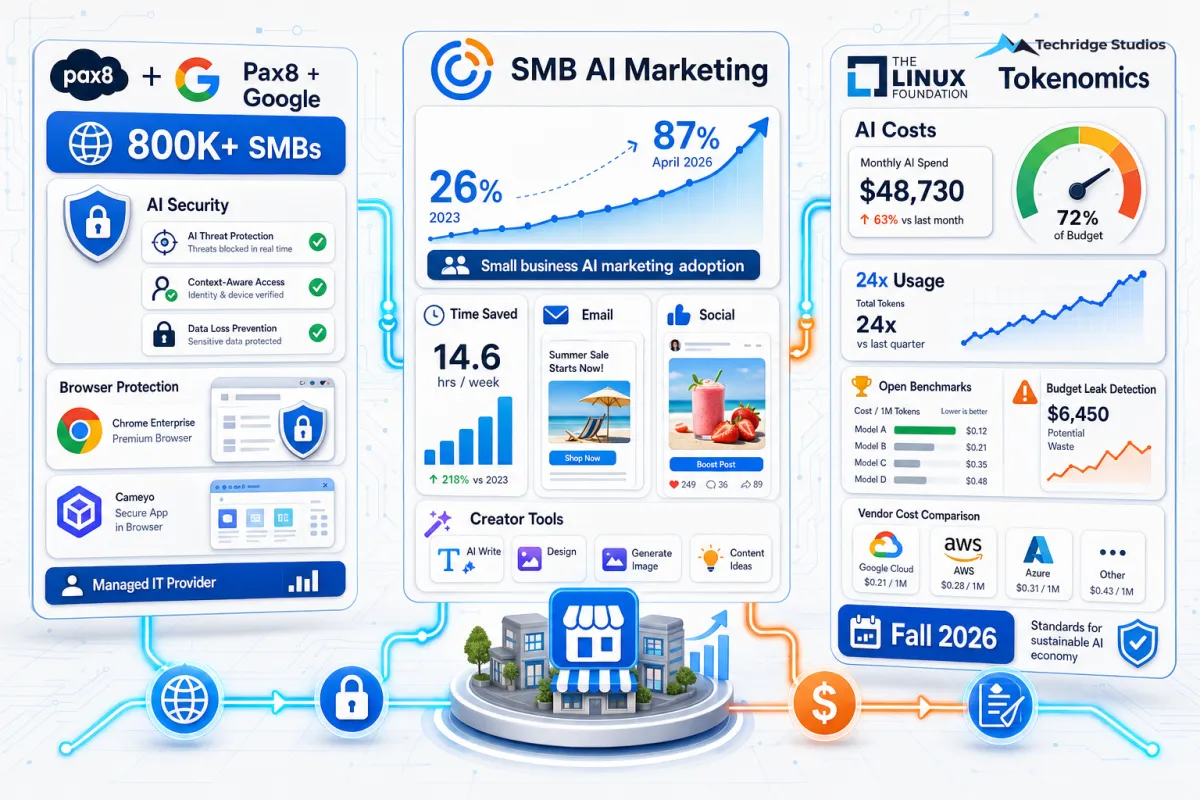
Small Business AI Has Crossed the Tipping Point — and the Cost Bill Is Arriving
Three reports released on June 10th, 2026, draw a sharper picture of where small businesses stand with AI at mid-year: most are now using it for marketing, enterprise tools are newly accessible through existing IT partners, and the cost of running AI is rising faster than most organizations can measure.
Small Business AI Marketing Adoption Hits 87 Percent
Constant Contact's 2026 Small Business Now report — based on a global survey of more than 5,000 small business owners and consumers — confirms what many practitioners already suspected: AI has moved from experiment to standard operating procedure in small business marketing.
AI adoption in small business marketing stood at 26 percent in 2023. By April 2026, that number had climbed to 87 percent. The shift happened in three years. According to Constant Contact's platform data, businesses using AI cut email production time by up to 23 percent — not a minor efficiency gain, but a material reduction in the hours a small business owner spends on content each week.
The report also reveals a meaningful shift in consumer behavior that parallels the AI adoption story. Consumer preference for shopping at small businesses has nearly tripled in the U.S. since 2021, from 10 percent to 27 percent. Social media has overtaken traditional search engines as the top channel through which consumers discover new small businesses, with 49 percent of global consumers using social platforms to find businesses, compared to 40 percent using search engines.
The practical takeaway is direct. If your competitors have moved from 26 percent to 87 percent adoption in three years, the question is no longer whether AI belongs in your marketing workflow. It is the tools you are using, how consistently you use them, and how well. Businesses that are not yet using AI for marketing are now the exception, not the rule.
Google Enterprise Tools Land in the Small Business Marketplace
For most of the last decade, enterprise-grade cybersecurity and application management tools were priced and designed for large companies with dedicated IT teams. That barrier is getting smaller.
Pax8 — the global cloud and AI marketplace that serves more than 800,000 small and medium-sized businesses through 47,000 managed service provider partners — announced a global partnership with Google on June 10th. Google's Chrome Enterprise Premium and Cameyo virtualization product are now available through the Pax8 Marketplace to partners worldwide.
Chrome Enterprise Premium combines AI-powered threat protection, context-aware access controls, and advanced security features built into the browser itself. Cameyo allows businesses to run legacy and client-based applications — including Progressive Web Apps — inside a secure browser environment, eliminating the need for traditional virtual desktops or VPNs. Both products are immediately available to small business customers through their managed IT service providers.
The business impact is straightforward. A small retail operation, a regional healthcare practice, or a growing professional services firm can now access the same category of AI-driven endpoint security that enterprise companies have been using for years — without building an internal security team. The managed IT provider handles the deployment. The small business gets the protection. The Pax8 model makes this distribution possible at a scale and price point that the direct-to-enterprise model never would have reached.
AI Token Costs Are Rising — and Most Businesses Cannot Track Them
The cost of running AI is no longer a footnote. It is a budget line — and for many businesses, it is already out of control.
The Linux Foundation announced the Tokenomics Foundation on June 3rd, 2026, and followed on June 10th with the announcement of Tokenomicon, a new annual conference dedicated to the economics of AI infrastructure spending. The first regional Tokenomicon event is scheduled for Amsterdam in September 2026, with a flagship conference in San Diego in June 2027.
The problem the Tokenomics Foundation is built to solve is this: AI is now being charged by the token — the unit of text processed in each AI interaction — and the cost per token, which fell sharply from 2023 to 2025, has leveled off and is rising again with new model releases. Goldman Sachs projects global token usage will multiply 24 times between 2026 and 2030, reaching 120 quadrillion tokens per month. Separately, industry analysts forecast more than 1 trillion dollars in AI infrastructure investment through 2027. The inference market alone is projected to expand from approximately 106 billion dollars in 2025 to 255 billion dollars by 2030.
Most businesses have no way to compare what they are paying for AI across different vendors, models, or use cases. The Tokenomics Foundation is building the open standards and benchmarks that would make those comparisons possible. Founding supporters include Accenture, Google Cloud, IBM, JPMorganChase, Microsoft, Oracle, Salesforce, and ServiceNow.
For a small business, this matters in a concrete way. If your team uses three or four AI tools — a writing assistant, a customer service chatbot, a data analysis tool, an image generator — you are likely paying token-based costs across all of them with no shared benchmark for whether the price is fair or the usage is efficient. The Tokenomics Foundation will not solve that problem overnight, but its benchmarks, when published, will give small businesses a neutral reference point for the first time.
What This Means for Your Business
The three stories from June 10th, 2026, share a common thread: AI has moved from optional to structural for small businesses, and the next problem to manage is not adoption — it is accountability.
If you are among the 87 percent already using AI for marketing, the next step is to measure what it is actually producing. If you are not yet in that group, the data make it clear what your competitors are doing. And regardless of where you are on AI adoption, the cost question is coming for every business running AI at any meaningful scale. Start tracking AI spend the same way you track payroll, advertising, or software subscriptions — by tool, by use case, and by outcome.
Start with one audit: pull your AI tool costs for the last 30 days and compare them to the business results they produced. That single exercise will tell you more than any report.
Sources
Constant Contact / PR Newswire — https://www.prnewswire.com/news-releases/the-rise-of-the-smb-creator-how-small-businesses-are-leveraging-social-media-and-ai-to-capture-consumer-attention-302796180.html
Pax8 / GlobeNewswire — https://www.globenewswire.com/news-release/2026/06/10/3310148/0/en/Pax8-and-Google-Announce-Global-Partnership-to-Equip-MSPs-and-their-SMB-Customers-with-Enterprise-Grade-Solutions.html
Linux Foundation / PR Newswire — https://www.prnewswire.com/news-releases/linux-foundation-announces-tokenomicon-a-new-conference-for-the-economics-of-ai-302796361.html