Small Business AI Goes Mainstream
Three stories landed this week that, together, mark something significant: AI is no longer a pilot program for small businesses. It is becoming standard operating procedure. Anthropic built a product specifically for you. The chips that power AI are now competing for your business. And the numbers show the majority has already crossed over.
Anthropic Built AI Specifically for Small Business — and It Is Already Wired Into Your Tools
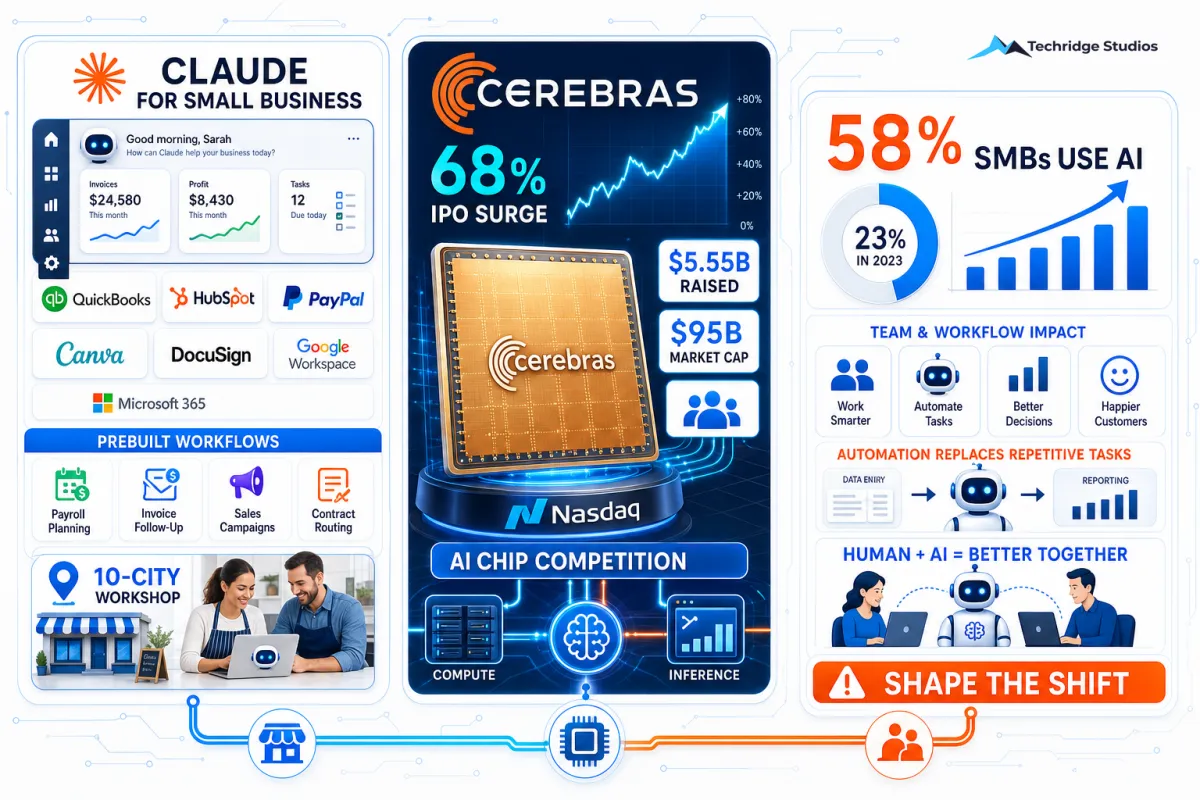
On May 13, 2026, Anthropic launched Claude for Small Business — a packaged set of connectors, agentic workflows, and ready-to-use skills that put Claude inside the software small businesses already run. The integration list covers the full operational stack: QuickBooks for accounting, PayPal for payments, HubSpot for sales and marketing, Canva for design, DocuSign for contracts, Google Workspace for collaboration, and Microsoft 365 for productivity.
The key word is prebuilt. There is no API setup, no developer contract, and no custom implementation project. Workflows for payroll planning, invoice follow-up, month-end reconciliation, sales outreach, and contract routing are included and ready to activate. A small business owner can connect their existing tools and start running automated workflows in a single session.
Anthropic framed the launch explicitly around an adoption gap. Small businesses represent 44 percent of U.S. GDP and employ nearly half the private-sector workforce, yet their AI adoption has consistently lagged behind larger enterprises. Claude for Small Business is a direct attempt to close that gap with a purpose-built, no-code product rather than an enterprise platform with a high learning curve.
The launch also includes a physical component: a free 10-city AI fluency tour that started May 14 in Chicago. Each stop offers a half-day workshop for up to 100 local small business leaders, with hands-on time on the platform. Upcoming cities include Tulsa, Dallas, New Jersey, Baton Rouge, Birmingham, Salt Lake City, Baltimore, San Jose, and Indianapolis. If you are near any of these stops, attendance is free and worth the half day.
Cerebras Went Public — and AI Chip Competition Is Now a Market Force
On May 14, 2026, Cerebras Systems debuted on Nasdaq in one of the largest U.S. tech IPOs in years. The company priced shares at 185 dollars, opened at 350 dollars, and closed up 68 percent — raising 5.55 billion dollars and reaching a market capitalization of approximately 95 billion dollars. By any measure, this is a signal, not noise.
Cerebras builds the Wafer Scale Engine 3, a processor engineered on a single silicon wafer — a fundamentally different architecture from Nvidia's approach of stitching smaller chips together. The company argues this design delivers faster inference at lower energy cost, which translates directly to cost-per-query reductions for anyone running AI workloads. OpenAI already committed to a 20 billion dollar multi-year computing deal with Cerebras, signaling that the largest AI consumer in the world is already diversifying away from Nvidia dependence.
What does this mean for a business that does not buy chips? Competition. When Nvidia faces a credible alternative at scale, pricing pressure follows. That pressure moves downstream through cloud providers, AI platform companies, and eventually the per-seat pricing on the tools small businesses pay for every month. The Cerebras IPO is not just a Wall Street story — it is an early signal that the AI infrastructure layer is maturing from a monopoly toward a market, and market competition almost always benefits buyers.
Watch this space through the rest of 2026. If Cerebras delivers on its performance and cost claims with enterprise customers, the infrastructure alternatives to Nvidia will grow, and the downstream cost of AI will continue to fall.
More Than Half of Small Businesses Now Use Generative AI — and the Workforce Implications Are Real
Time Magazine published a deep-dive report on May 14, 2026, examining how small businesses — not just tech companies — are actively restructuring around AI. The headline data is significant: 58 percent of U.S. small businesses now use generative AI, up from 23 percent in 2023. That is a 35-point jump in two years. The majority has crossed over.
The more complex part of the story is what is happening to headcount. Hospitable, a short-term rental management platform, increased its AI spending by 50 percent — a sum the company equates to the cost of three full-time employees. That is not just an efficiency story. It is a staffing story. The Time report notes that small firms may actually lead this restructuring rather than follow it, because they can reorganize around new technology faster than larger enterprises with more complex org structures and longer decision cycles.
The broader workforce backdrop is stark. Q1 2026 saw 78,557 tech-sector layoffs, with nearly 50 percent attributed to AI-driven automation. Small businesses are not immune to that trend. But the businesses in the story are not cutting their way to growth — they are redeploying capacity. The question for every small business owner is not whether AI will affect your team structure. It is whether you are the one making that decision intentionally, or whether the decision gets made for you by a competitor who moved faster.
The window to shape this transition — to define which tasks AI handles, what humans focus on, and how your team evolves — is open now. It will not be open indefinitely.
What This Means for Your Business
This week's three stories point in the same direction. The tools are production-ready and prebuilt for your software stack. The infrastructure is maturing and getting cheaper. And the majority of your peers have already started.
The single most useful action you can take today: go to claude.ai, review the Small Business plan, and connect one tool you already use — QuickBooks or Google Workspace is the fastest starting point. Run one automated workflow this week. Start with something small, like invoice follow-up or a sales email sequence. The goal is not a full transformation on day one. It is putting AI into a real workflow so you learn what works for your business before your competition does.
Sources
TechCrunch — https://techcrunch.com/2026/05/13/anthropic-courts-a-new-kind-of-customer-small-business-owners/
Anthropic — https://www.anthropic.com/news/claude-for-small-business
CNBC — https://www.cnbc.com/2026/05/14/cerebras-cbrs-stock-trade-nasdaq-ipo.html
Fortune — https://fortune.com/2026/05/14/cerebras-one-of-the-biggest-ipos-of-the-year/
Time Magazine — https://time.com/article/2026/05/14/ai-small-businesses-layoffs/