Small Business AI Winners Are Pulling Ahead — Here's the Data
A pattern is emerging in 2026: the small businesses deploying AI are measurably outperforming those that are not, the cost of starting a company has hit historic lows, and even tech giants are now competing for AI computing capacity. Three data points, one direction.
The AI Deployment Divide Is Now Measurable
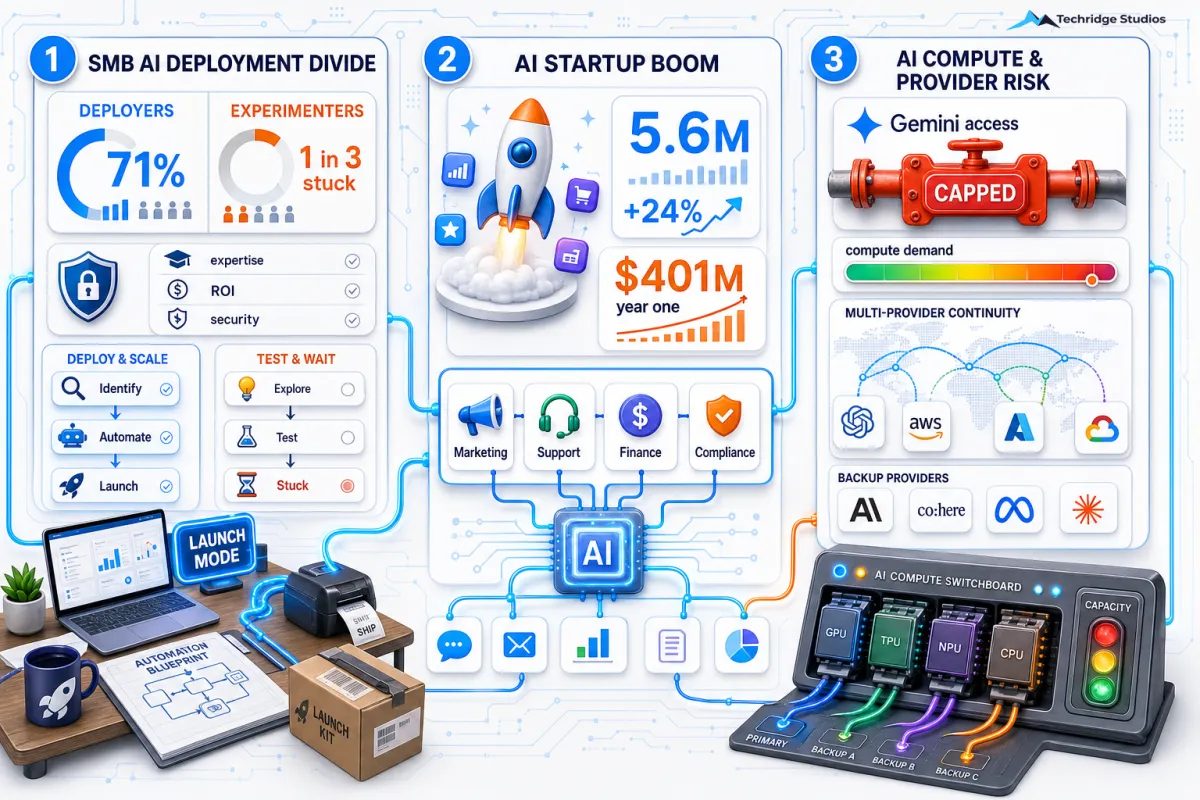
Pax8, the global AI and cloud marketplace for small and mid-size businesses, released its Q2 2026 SMB AI Pulse Report on July 13th, surveying 402 U.S. small business leaders across a range of industries. The headline number: 71 percent of SMBs actively using AI say it gives them the ability to compete with much larger companies.
But that is not the full story. AI users are nearly three times as likely to say they are ahead of competitors on technology (31 percent versus 12 percent for non-users). They are more confident in business growth (65 percent are very or extremely confident, versus 56 percent for non-users). And they are twice as likely to describe their approach to technology as proactive.
The uncomfortable counterpoint: one in three AI-using SMBs is stuck in experimentation. They are testing tools but cannot advance to real deployment. The top three barriers are lack of internal expertise (28 percent), unclear return on investment (24 percent), and security or privacy concerns (21 percent).
This is the gap that matters most for small business owners right now. The businesses pulling ahead are not using more sophisticated tools — they are simply further along in the process of wiring those tools into their actual workflows. Leadership alignment (91 percent of active deployers versus 68 percent of experimenters) and documented governance policies (two-thirds of deployers versus one-third of experimenters) are what separate the two groups. If you are in the stuck middle — you have tried AI but have not built a system around it — the clock is running.
AI Has Made It Cheaper Than Ever to Start a Business
On July 14th, 2026, PYMNTS reported on new Citadel Securities research showing that U.S. business applications hit 5.6 million in 2025, up 24 percent since ChatGPT launched in late 2022. The strongest growth is concentrated in sectors most exposed to AI — services, telehealth, media, and professional services.
The economic explanation is straightforward. AI is lowering what economists call the minimum efficient scale of a business — the revenue threshold at which it becomes economical to hire specialists for each function. A founder who once needed separate employees for accounting, customer service, marketing, and compliance can now handle all four with AI tools and a much smaller team. The barrier to entry has dropped.
The most concrete proof of this shift: Matthew Gallagher launched Medvi, a GLP-1 weight-loss telehealth startup, from his Los Angeles home in September 2024. He started with 20,000 dollars and no employees. In Medvi's first full year, the company posted 401 million dollars in revenue with a 16.2 percent net profit margin — using only off-the-shelf AI tools. ChatGPT and Claude handled code and copy. Midjourney and Runway produced ads. ElevenLabs powered voice-based customer communication. Custom AI agents connected the systems.
Gallagher did not build proprietary technology. He built the right stack. In 2026, building a viable company is less about what you invent and more about how effectively you deploy tools that already exist. For small businesses already operating, the same principle applies — every function that once required a dedicated hire can be at least partially handled by AI, reducing overhead and increasing margin.
Google Ran Out of AI Compute — And That Affects You
Google capped Meta's access to its Gemini AI models after Meta requested more computing capacity than Google could supply, delaying some of Meta's internal AI projects. The same week, TSMC — the world's dominant chip manufacturer — reported record quarterly revenue of 39.62 billion dollars, up 36 percent year over year, driven entirely by AI chip demand.
This tells you something important: AI compute is now the binding constraint in the industry, even for the largest and wealthiest companies. When Google has to ration its best models to a paying enterprise customer, it means capacity is tight, and that tightness has downstream effects on pricing, access, and availability across the board.
For small businesses, the practical implication is this: if you have built your workflows around a single AI provider — one subscription, one platform, one model — you are carrying more risk than you may realize. Provider pricing can change. Capacity can tighten. Access tiers can shift. The smart move is diversification — knowing which critical functions depend on which providers, having at least one backup for your most important workflows, and building systems that are not locked to a single vendor.
What This Means for Your Business
Today's three stories point in the same direction: the businesses winning with AI in 2026 are not the ones with the biggest budgets. They are the ones that have moved from testing to deployment, built multi-tool workflows instead of single-provider dependencies, and treated AI as a business system — not a feature.
The one action worth taking this week: map your current AI stack. Write down what tools you use, what functions they cover, and what would break if any one of them became unavailable or more expensive. That map is the starting point for a real AI strategy. More resources at www.techridgestudios.com/insights.
Sources
Pax8 Q2 2026 SMB AI Pulse Report — https://www.globenewswire.com/news-release/2026/07/13/3326217/0/en/Pax8-Research-Finds-Small-Businesses-All-in-on-AI-with-2-in-3-Projecting-Stronger-Competitive-Composure.html
PYMNTS (citing Citadel Securities) — https://www.pymnts.com/news/artificial-intelligence/2026/ai-is-quietly-fueling-americas-small-business-boom/
Build Fast with AI — https://www.buildfastwithai.com/blogs/ai-news-today-july-14-2026