Social Media Now Beats Google for Small Business Discovery — And AI Is Why That's Possible
The biggest AI stories today aren't about new model releases or chip announcements. They're about how small businesses are using AI to compete for customers and whether the results are actually showing up. A new global study shows social media has officially overtaken search as the top way consumers find small businesses. A second study finds that 87 percent of small businesses use AI tools — but most can't measure what those tools produce. And a third data set reveals that clients are actively grading their professional service providers on AI delivery, with $143 billion in revenue at stake.
Social Media Has Overtaken Search as the Top Discovery Channel for Small Businesses
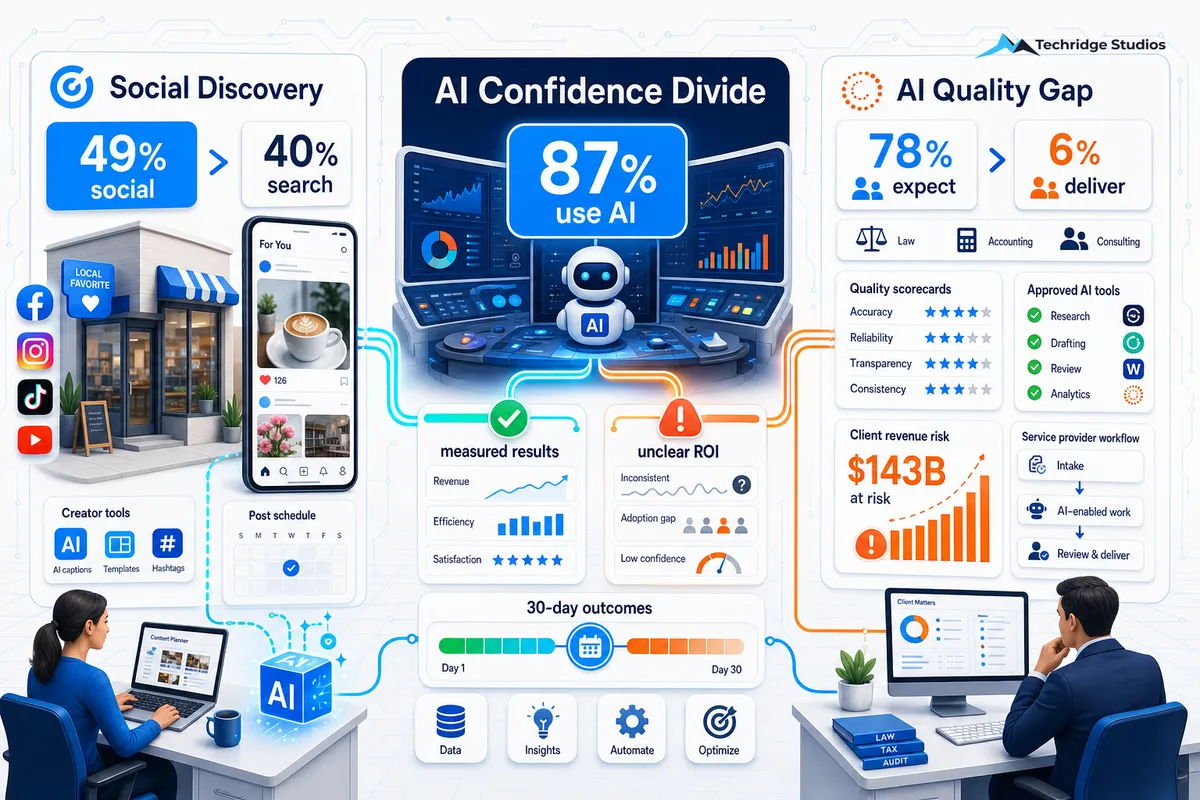
Constant Contact released findings from its global Small Business Now report on June 10th, 2026, based on a survey of more than 5,000 small business owners and consumers across multiple countries. The headline number: 49 percent of consumers globally now use social media as their primary tool for discovering new small businesses — ahead of search engines at 40 percent. That gap has been building for years, but 2026 marks the first time social has pulled decisively ahead.
The AI angle is what makes this trend actionable. In the U.S., SMB adoption of AI in marketing surged from 26 percent in 2023 to 87 percent by April 2026. The primary reason: time savings. Creating and scheduling social content used to be a half-day task. With AI tools generating first drafts of posts, captions, and graphics, business owners are posting more consistently at a fraction of the effort. Seventy-three percent of small business owners globally now identify as "creators" — meaning they produce original content themselves, often with AI assistance, rather than outsourcing to agencies.
The consumer shift compounds the urgency. Preference for shopping "mostly at small businesses" has nearly tripled since 2021, rising from 10 percent to 27 percent. That growing consumer goodwill is being captured by businesses that show up consistently on social — not by those with the biggest ad budgets. The audience is there. The question is whether your business is showing up to meet them.
For small business owners not yet posting consistently on social media, this data reframes the stakes. It's not just a nice-to-have marketing strategy — it's the primary channel your potential customers are using to find businesses like yours. AI tools that help you create and schedule content consistently are no longer a convenience; they're a competitive requirement.
87 Percent Use AI — But the "AI Confidence Divide" Is the Real Story
Bluehost released its inaugural State of Small Business AI Confidence study on June 25th, 2026, and the headline number is striking: 87 percent of U.S. small businesses already use at least one AI tool, with more than half using AI every day. By almost any measure, AI adoption among small businesses has reached near ubiquity.
But the study's more significant finding is what comes after adoption. Bluehost identifies an "AI Confidence Divide" as the emerging fault line — a split between small businesses that use AI in ways that produce measurable results and those that have adopted AI tools without yet seeing clear results. Having a ChatGPT subscription or using an AI feature inside a design tool does not automatically translate to business outcomes. The gap between usage and results is where the opportunity now lives.
For small business owners, this finding changes the right question to ask. The conversation is no longer "should we be using AI?" — 87 percent of your peers already are. The question is whether you're using AI in a structured, intentional way that you can measure. If you cannot point to a specific process or outcome that AI has improved in the last 30 days, that is the gap worth addressing.
A practical first step: map every current AI tool your team uses to a specific business process. If a tool doesn't have a named process attached to it, it's either a luxury subscription or an automation opportunity that hasn't been activated yet. Most businesses uncover three to five clear automation candidates in this exercise that they haven't acted on.
Clients Are Already Grading Professional Services Firms on AI
Thomson Reuters released its 2026 Future of Professionals report on June 22nd, 2026, drawing on surveys of more than 1,800 professionals across 62 countries in law, accounting, tax, audit, and compliance. The core finding is direct: 78 percent of corporate clients now consider AI-enabled quality improvements essential from their service providers. Only 6 percent believe most firms are actually delivering on that expectation.
That gap — 78 percent expecting it, 6 percent finding it — puts the scale of the challenge in plain terms. The financial exposure is significant. Thomson Reuters estimates that up to $143 billion in client revenue is at risk in the U.S. alone as clients reassess which service providers are genuinely using AI to improve their work and which are operating the same way they did in 2023.
The talent dimension compounds the risk. Almost three in ten mid-career professionals said they would change jobs within two years if AI fails to deliver expected value at their firm. And one-third of lawyers, accountants, and compliance professionals are already using AI tools that their organizations have not approved — a clear signal that demand is outpacing policy in many firms.
For small businesses in any professional service field — consulting, legal, accounting, financial services, HR, marketing agencies — the takeaway is direct: clients are not waiting for the technology to mature before forming opinions. They are forming them now. The firms that can point to specific AI-driven improvements in quality, speed, or accuracy will have a measurable advantage in retention and referrals over the next 12 months.
What This Means for Your Business
Three stories, one clear pattern: the basics of competing for small businesses have shifted. Social media now drives more customer discovery than search — and AI is what makes consistent social output achievable for a small team. AI adoption is near-universal, but results are not. And for businesses that serve other businesses, clients are actively evaluating whether your firm is keeping pace.
The next step is practical: check your analytics to see whether social or search is sending you more new customers. Audit which AI tools your team uses and map each to a measurable outcome. And if you run a professional service firm, ask honestly whether your clients could point to a single way your firm's AI use has improved the quality or speed of your work in the last 90 days.
Sources
Constant Contact / PR Newswire — https://www.prnewswire.com/news-releases/the-rise-of-the-smb-creator-how-small-businesses-are-leveraging-social-media-and-ai-to-capture-consumer-attention-302796180.html
Bluehost / PR Newswire — https://www.prnewswire.com/news-releases/bluehost-launches-inaugural-market-study-on-state-of-small-business-ai-confidence-in-the-us-302810857.html
Thomson Reuters — https://www.thomsonreuters.com/en/press-releases/2026/june/ai-is-ready-but-firms-are-not-how-falling-behind-on-ai-implementation-is-costing-clients-and-talent