The AI Gap Is Real — And It's Getting Wider
Three things happened in the AI space this week that every small business owner should know about. Taken together, they tell a clear story: the window to get ahead with AI is still open, but it's not open forever.
Most AI Gains Are Going to a Small Group of Businesses
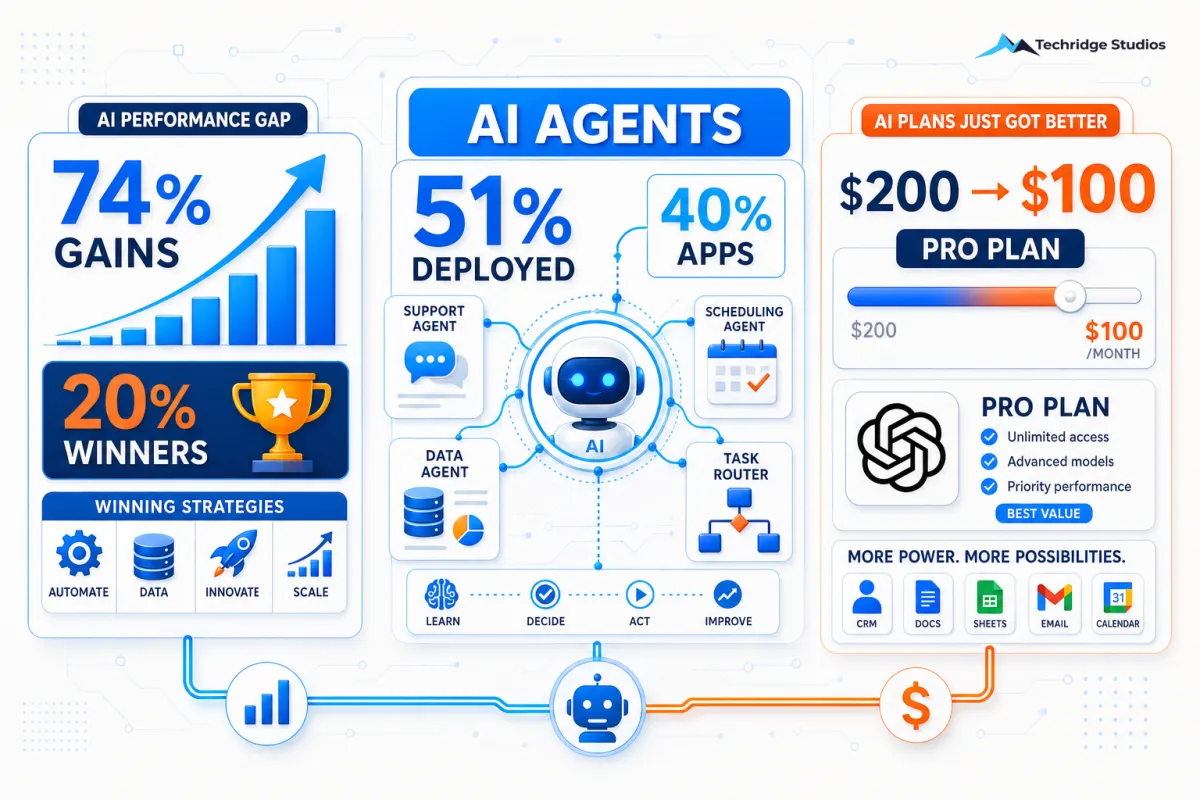
PwC just released findings from a global study of 1,217 senior executives, and the headline number is hard to ignore: 74% of AI's economic gains are going to just 20% of companies. That's not a small gap — that's a chasm. And the thing separating those top performers from everyone else isn't budget or headcount. It's strategy.
The companies capturing the most value from AI are using it to grow — to reach new customers, build better offers, and reshape how they operate. The ones falling behind are mostly using AI to trim costs or automate admin tasks. Efficiency alone isn't a growth strategy. If your AI use stops at "it saves me an hour a week," this study is a direct signal that you're leaving value on the table.
The Price Barrier Just Got Smaller
OpenAI cut its Pro plan from $200 to $100 per month — a 50% reduction. ChatGPT Business seat pricing dropped by $5/month as well. Anthropic is adding enterprise-grade controls to Claude, signaling that competition at the top is heating up.
For small businesses that have been sitting on the sidelines because the tools felt too expensive, this is a real shift. The gap between what enterprise teams can access and what a small business can afford is narrowing. What to do right now: if you've been evaluating ChatGPT Pro or a similar platform and cost was the sticking point, run the numbers again. The pricing just changed.
AI Agents Are Already Running Inside Most Businesses
The phrase "AI agent" has been tech-world buzzword material for the past year. It's not anymore. More than half of companies — 51% — have already deployed AI agents, which are software programs that independently complete multi-step tasks: handling customer questions, booking appointments, processing and routing data, flagging issues before a human sees them.
Gartner predicts that 40% of all business applications will include task-specific AI agents by the end of 2026. That's up from under 5% just a year ago. If you're running customer support, scheduling, or any kind of intake workflow manually — or using a basic chatbot — you're comparing yourself to a baseline that's moving fast.
What This Means for Your Business
The research is pointing in one direction: AI is becoming a dividing line, not a differentiator. The businesses that figure out how to use it to grow — not just to save time — are pulling ahead. The tools are cheaper than they were last week. The technology to automate complex workflows is already deployed by the majority of your competitors. The question isn't whether to get started. It's whether you're using AI to play offense or just triage.
Sources
PwC 2026 AI Performance Study — https://www.pwc.com/gx/en/news-room/press-releases/2026/pwc-2026-ai-performance-study.html
OpenAI / Engaget — https://www.engadget.com/ai/openai-has-a-new-100-chatgpt-pro-plan-to-better-match-up-with-claude-062705626.html