Three AI Moves Today That Every Small Business Owner Should Know About
Three things happened in AI today — and each one affects a different corner of how small businesses operate. An AI model is now patching security vulnerabilities in the open-source software your business runs on. A popular AI automation tool just moved behind a paywall. And Microsoft made a long-awaited commitment that makes its AI tools a plannable investment for the first time. Here is what you need to know.
OpenAI's GPT 5.5 Cyber Is Patching the Software Your Business Depends On
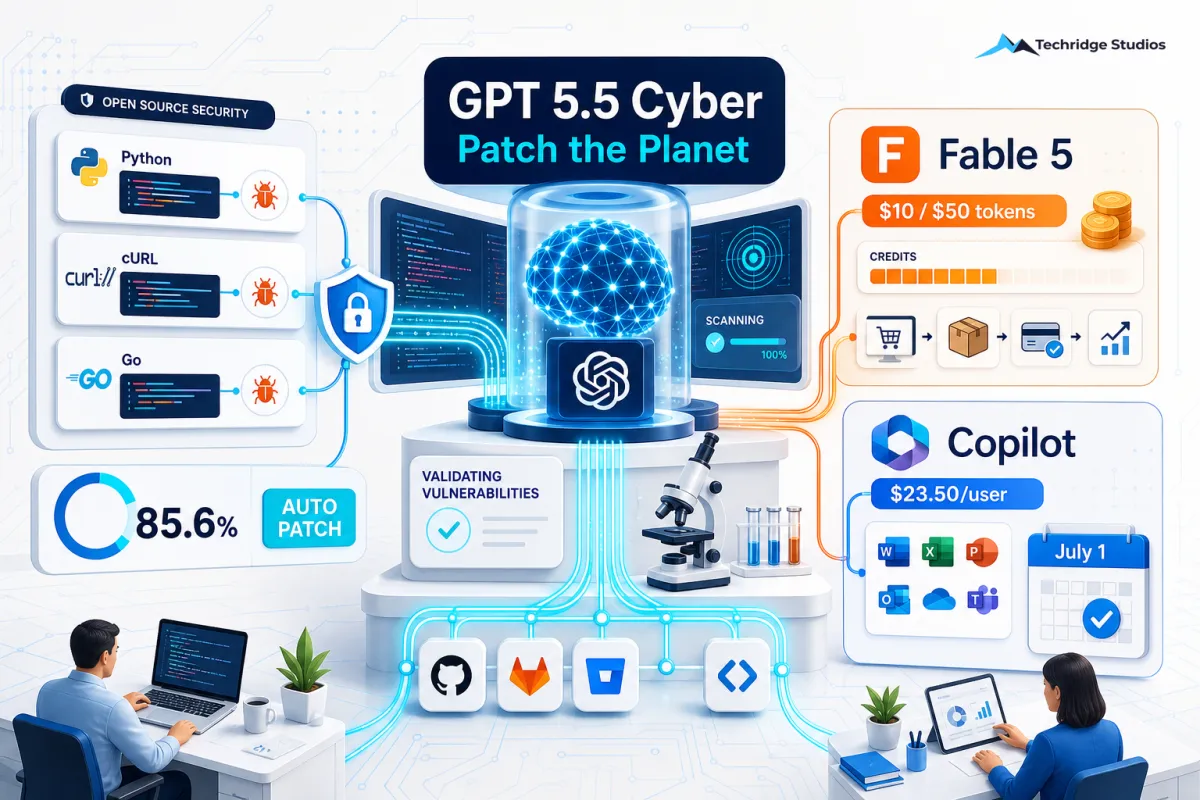
OpenAI today launched the full version of GPT 5.5 Cyber alongside an initiative called Patch the Planet, built in partnership with cybersecurity firm Trail of Bits and bug bounty platform HackerOne. More than 30 widely used open-source projects signed on to participate, including Python, cURL, Go, Sigstore, and pyca/cryptography — projects that underpin a significant portion of the internet, including the web applications, payment systems, and internal tools that small businesses rely on every day.
The model achieved 85.6 percent on CyberGym — the leading AI cybersecurity benchmark — and was used to automatically scan large codebases, identify vulnerabilities, validate them in controlled environments, and generate working patches. Trail of Bits engineers reported that GPT 5.5 Cyber built a complete fuzzing lab — a testing environment that systematically probes for security bugs — in less than a day. The same work would have taken several weeks manually.
For small businesses, the immediate impact is indirect but meaningful. The open-source tools your IT team, developers, web vendors, and software-as-a-service providers depend on are now subject to AI-driven security review at a scale that was not possible before. The Patch the Planet initiative will continue scanning and patching, meaning the software supply chain your business sits inside is gradually getting stronger without you having to manage it.
The longer-term implication is more significant. AI-driven security is shifting from a capability that only large enterprises could afford to something embedded in development infrastructure itself. For small businesses evaluating vendors or assessing tools, the questions to start asking are: does this vendor participate in security initiatives like this? Are they patching known vulnerabilities quickly? Increasingly, AI will be doing that work — and the businesses that work with vendors who embrace it will carry less risk.
Claude Fable 5 Just Got Expensive — Here Is What That Means for Your Workflow
Anthropic's Claude Fable 5, the most capable publicly accessible AI model released earlier this month, ended its free subscription window today. As of June 23rd, 2026, Fable 5 requires usage credits on all plan types — Pro, Max, Team, and seat-based Enterprise. The pricing is $ 10 per million input tokens and $ 50 per million output tokens, which is double the cost of Claude Opus 4.8.
The impact on small businesses is real. A survey from Rewarx of more than 400 ecommerce operators found that 68 percent had built Fable 5 into at least one daily workflow before the change. Those uses ranged from generating product descriptions and drafting customer service responses to building content research pipelines and proposal documents. For teams that had started treating Fable 5 as a free utility, today's shift means a cost they had not budgeted for.
The practical question is whether Fable 5's quality is worth the premium for every task in your workflow. The answer for most small businesses is no — at least not for everything. Many routine tasks, such as summarizing emails, drafting short replies, generating lists, or light editing, do not require a frontier model. These can be handled well by lighter, cheaper models like Claude Haiku 4.5 at a fraction of the cost. The tasks where Fable 5 genuinely earns its premium are long, complex documents — multi-part analysis, research, detailed proposals — where a weaker model would produce noticeably worse output.
Anthropic has stated that the paywall is a capacity decision, not a permanent pricing tier, and intends to restore Fable 5 to standard subscription plans. No timeline has been announced. In the meantime, the smart move is to audit your AI usage, route low-complexity tasks to cheaper models, and reserve Fable 5 credits for work where the quality difference actually matters.
Microsoft 365 Business with Copilot Is Now a Permanent Plan — Here Is What to Know Before July 1st
Starting July 1st, 2026, Microsoft is converting its 365 Business with Copilot offerings from promotional bundles into permanent product lines. Microsoft 365 Business Standard with Copilot will be priced at $23.50 per user per month, and Microsoft 365 Business Premium with Copilot at $ 32 per user per month on annual billing for up to 300 seats.
Until now, Copilot has been sold to small businesses as a standalone add-on or as part of promotional bundles with expiration dates, making it difficult for owners and finance teams to treat AI as a stable operational cost. The permanent plan removes that uncertainty. Small businesses can now commit to Copilot-enabled plans with the same confidence they commit to any other software subscription.
What this means in practice is that if you are already paying for Microsoft 365 for your team, the math for adding Copilot just became much easier. At 23 dollars and 50 cents per user per month on the Standard plan, you get AI embedded directly into Word, Excel, PowerPoint, Teams, and Outlook — generating drafts, summarizing meetings, answering data questions in spreadsheets, and creating presentation outlines. For businesses already doing that work manually, the time savings start paying back quickly.
There is also a promotional offer running through December 31st, 2026: Microsoft 365 Business Basic plus Copilot Business is available at 21 dollars per user per month after a 25 percent discount. If your business is on the Basic plan and has been waiting for the right moment to try Copilot, that promotion provides a lower-friction entry point before committing to the Standard or Premium bundle.
What This Means for Your Business
Today's three stories point at the same underlying shift: AI is moving from discretionary to operational for small businesses. Security tooling, productivity platforms, and AI models are all settling into embedded, always-on models — and their pricing structures are following suit. What changes is your relationship to each of these tools: they are no longer experiments. They are line items.
The single best action to take today is a 20-minute AI workflow audit. Look at every tool your team uses that has an AI component, find out what model it runs on, check what it costs per task, and decide whether you are getting that value back in time savings. That clarity is the foundation of a smart AI budget — and it matters more now that the free windows are closing.
Sources
OpenAI — https://openai.com/index/gpt-5-5-with-trusted-access-for-cyber/
Rewarx — https://www.rewarx.com/blogs/claude-fable-5-pulled-from-subscriptions-ecommerce
Microsoft Learn / Partner Center — https://learn.microsoft.com/en-us/partner-center/announcements/2026-june