Three AI Moves Small Businesses Cannot Ignore
OpenAI opened a brand-new ad channel in Europe, the biggest AI agent standards bodies merged into one, and a knowledge engine upended accuracy benchmarks for enterprise AI tools. Each of these stories touches a different part of your business — marketing, infrastructure, and reliability.
ChatGPT Ads Are Now Live Across Europe
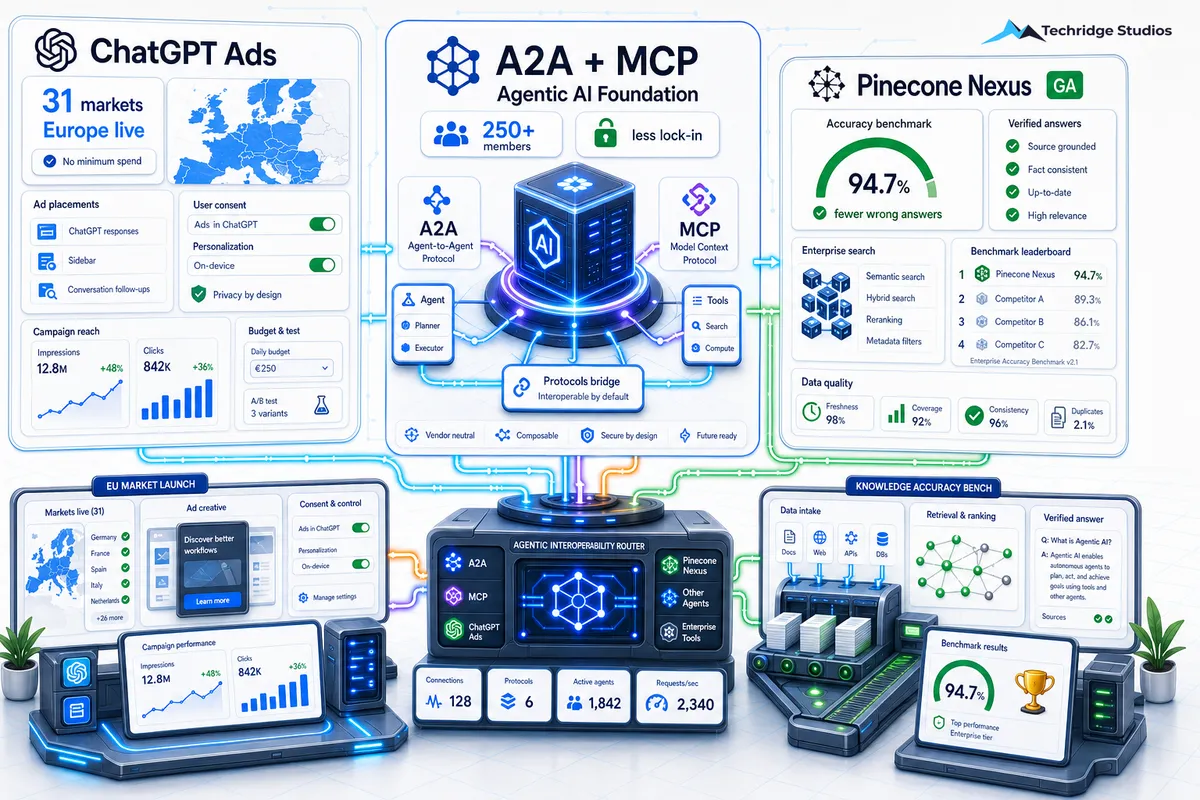
OpenAI launched ChatGPT advertising in 31 European markets on August 24th, 2026, marking the platform's largest single-day geographic expansion since its ads business launched in the United States in February.
European markets now covered include Germany, France, Spain, Italy, the Netherlands, Poland, Sweden, Norway, Denmark, and Ireland. Ads appear to free and Go plan users; Plus, Pro, Enterprise, Business, and Education accounts remain ad-free.
The expansion required extra time in Europe because EU data privacy regulations require explicit user consent for personalized ad targeting. OpenAI published an updated EU privacy policy on August 14th, 2026, and will rely on consent-based targeting rather than data sales in European markets.
For small businesses, this is a meaningful new option. ChatGPT reaches hundreds of millions of users who are actively searching for products, services, and solutions — a different behavior than passive social media browsing. OpenAI's vice president of ads emphasized that the company intends to meet European standards for relevance, quality, and trust.
The action for small businesses today: if you advertise on Google, Meta, or LinkedIn and you have European customers or growth ambitions in that region, monitor OpenAI's self-serve ads rollout for access. No minimum spend is required, and first-movers in new ad channels typically pay lower costs while the market learns to price inventory.
Agent Standards Consolidate — Less Lock-In for Small Businesses
Google's Agent-to-Agent protocol, known as A2A, officially became a hosted project of the Agentic AI Foundation on August 20th, 2026. The Foundation, which already governs Anthropic's Model Context Protocol, now counts more than 250 member organizations including Amazon Web Services, Anthropic, Block, Bloomberg, Cloudflare, Google, Microsoft, and OpenAI.
This is a significant governance shift. A2A defines how AI agents communicate with each other — passing tasks, capabilities, and context across systems. The Model Context Protocol defines how AI agents connect to external tools and data sources. Having both under the same neutral governance body means both standards can evolve in coordination rather than independently.
For small businesses, the practical effect is reduced lock-in. If the agent tools you buy today are built on A2A and the Model Context Protocol, you are less dependent on any single vendor. You can swap tools, add new capabilities, or switch providers without rebuilding your entire automation infrastructure from scratch.
The action: when evaluating AI agent tools or platforms, ask vendors specifically whether they support A2A and the Model Context Protocol. Prioritize vendors who do. The standard-backed stack is now the safer long-term bet.
Pinecone Nexus Goes Live — Agents That Give You Fewer Wrong Answers
Pinecone announced the general availability of Nexus, its enterprise knowledge engine, after the product topped the τ-Knowledge benchmark — a rigorous test of how accurately AI agents retrieve and use an organization's internal information. Nexus outperformed AI agents built on frontier models from OpenAI, Anthropic, and Google.
Nexus sits between an organization's proprietary data and its AI agents, acting as a governed, always-current knowledge layer. Instead of each AI workflow building its own retrieval pipeline, Nexus centralizes that function — meaning agents always pull from the same source and teams have one place to govern what the AI knows.
For small businesses, this matters even if you never deploy Nexus directly. The AI tools you already use — CRM assistants, workflow agents, customer service bots — are increasingly being rebuilt on infrastructure like Nexus. When the knowledge layer improves, the accuracy of your tools improves with it. The hallucination problem that makes teams distrust their AI tools has a structural fix, and Nexus is one of the first at general availability to prove it.
The action: if your AI tools frequently return outdated or inaccurate information, ask your vendor whether they use a dedicated knowledge retrieval layer. Accuracy problems in AI tools are rarely about the model — they are almost always about how that model accesses information.
What This Means for Your Business
Today's three stories represent three different layers of the AI opportunity for small businesses: where you reach customers (ChatGPT Ads in Europe), what tools you can trust long-term (A2A and Model Context Protocol standards), and how reliable your AI output will be (Pinecone Nexus).
The single action worth taking today: if you have European customers or are planning European expansion, check your eligibility for ChatGPT Ads. It is the most immediately actionable story in this brief, and first-movers in new ad channels typically pay lower costs while the market learns to price the inventory.
Sources
OpenAI — https://openai.com/index/chatgpt-ads-expands-across-europe/
Dataconomy — https://dataconomy.com/2026/08/19/openai-chatgpt-ads-launch-european-markets-august-24/
AI Agent Store — https://aiagentstore.ai/ai-agent-news/this-week