Three AI Stories Every Small Business Owner Should Read This Week
AI tools are everywhere right now. But the headlines this week aren't about hype — they're about what's actually working, what's failing, and what could be quietly costing you. Here's what happened on April 7, 2026, and what it means for your business.
Google Just Made Free Offline Dictation a Reality
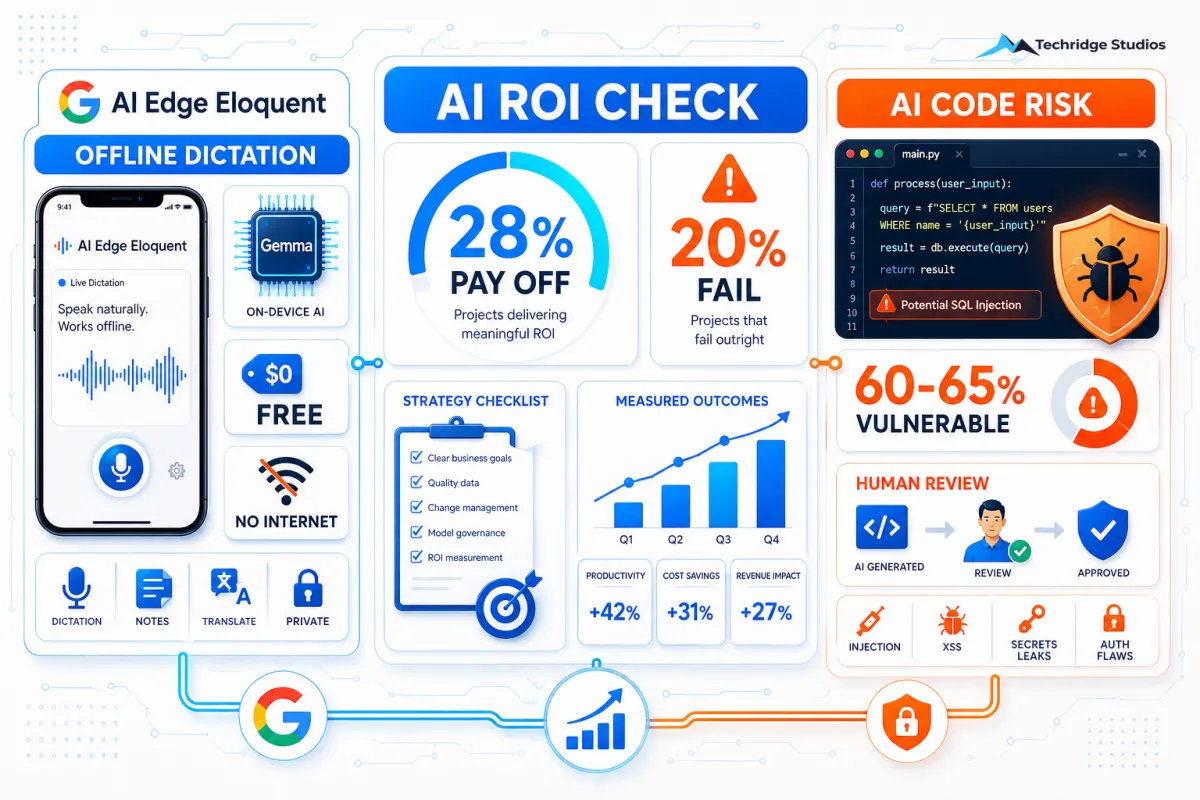
Google released AI Edge Eloquent, a free iOS app that handles professional-grade voice transcription — entirely on your device. No internet connection. No monthly fee. It runs on Google's Gemma AI model, which processes everything locally. That means your recordings stay private, you can use it anywhere, and it costs nothing.
For small businesses, the immediate question is simple: are you paying for transcription software right now? Services like Otter, Rev, or Descript can run $10–$30 per month per user. If your team is doing field interviews, client calls, or voice notes, AI Edge Eloquent is worth testing before your next billing cycle hits.
The action here is easy: download it, run three real-world tests against whatever you're currently using, and decide. You have nothing to lose — it's free.
Gartner Says Most AI Projects Still Don't Pay Off
This is the one that should make every business owner pause before signing up for another AI tool. Gartner's data shows that only 28% of AI deployments in operations deliver meaningful returns. Another 20% fail entirely. That means more than half of businesses spending on AI aren't getting a clear return.
The businesses that succeed with AI aren't necessarily smarter or better funded. They start with a specific, measurable problem and work backward to find the right tool. They don't buy AI and then figure out where to use it. That order matters.
If you're evaluating AI tools right now, write down the answer to this question before spending anything: what specific outcome will change, and how will you measure it in 90 days? If you can't answer that clearly, you're not ready to buy yet. That's not a failure — that's smart.
AI-Generated Code Has a Security Problem You Can't Ignore
Research from Digitain found that 60–65% of code produced by AI coding tools — including popular options like GitHub Copilot and ChatGPT — contains security vulnerabilities. These aren't theoretical risks. They're the kind of flaws that show up in penetration tests and, in worse cases, get exploited.
This story matters even if you're not a developer. If you have anyone on your team using AI to write code, build automations, or modify your website, the output needs a human review before it goes live. That review doesn't have to be an expensive security audit every time — it means someone technically literate checks the logic before anything touches your live environment.
The specific action: add a one-line policy to your AI usage guidelines that says AI-generated code requires human review before deployment. That single rule can prevent a significant class of problems.
What This Means for Your Business
Three different stories, one consistent theme: AI tools are widely available and increasingly free, but using them well still requires human judgment. A free dictation app doesn't replace your process — it improves it. A Gartner stat about ROI doesn't mean AI doesn't work — it means strategy comes first. And AI-generated code isn't unusable — it just needs a second set of eyes.
The businesses pulling ahead right now are the ones treating AI as a tool that needs management, not a solution that runs itself.
Sources
Hipther AI Dispatch (TechCrunch / Google AI Edge Eloquent) — https://hipther.com/latest-news/2026/04/07/109770/ai-dispatch-daily-trends-and-innovations-april-7-2026-anthropic-samsung-google-tharaa-labs-and-givaudan-haut-ai/
TechStartups (Gartner AI ROI data) — https://techstartups.com/2026/04/07/top-tech-news-today-april-7-2026/
Radical Data Science / Digitain (AI-generated code security) — https://radicaldatascience.wordpress.com/2026/04/07/ai-news-briefs-bulletin-board-for-april-2026/