Transcription at 10 Cents, Software You Can Skip, and Voice AI Merging With Chat
Three stories landed today that share a common thread: the cost of doing business with AI keeps dropping, even as the question of what you actually get for it grows louder.
Microsoft Cuts Transcription to 10 Cents Per Hour
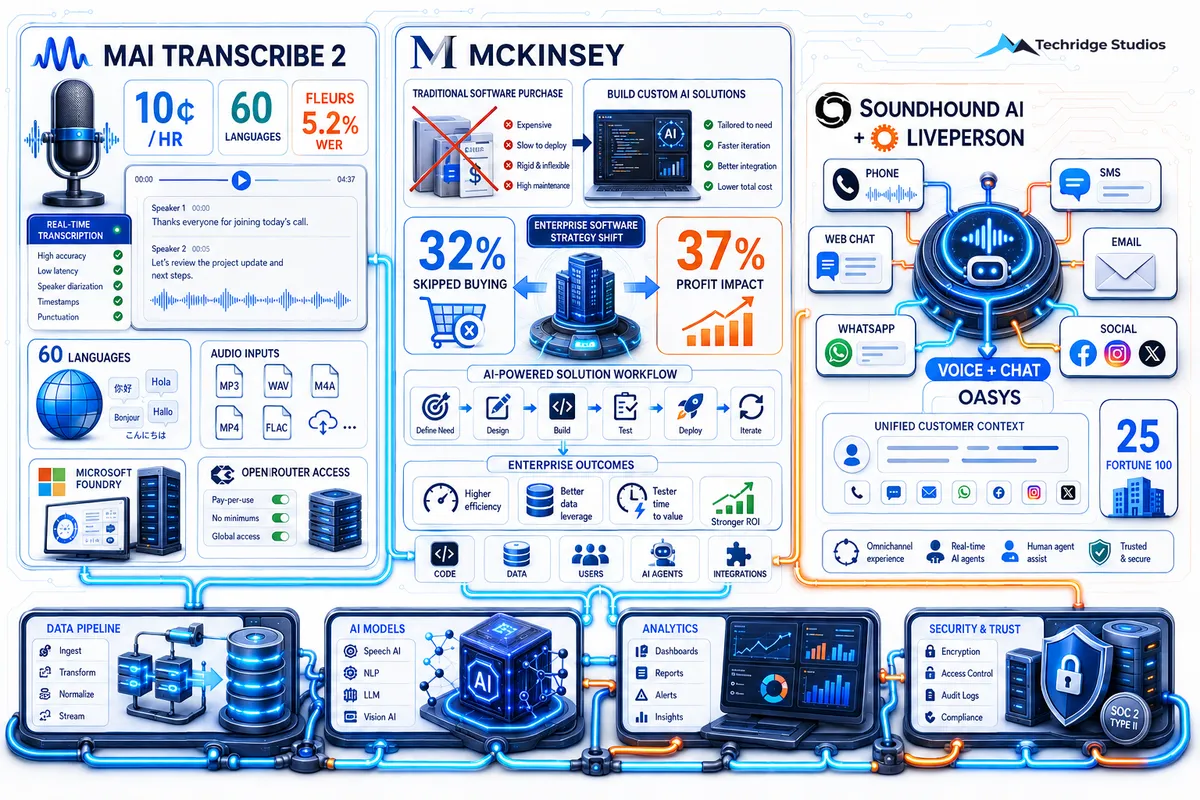
Microsoft released MAI Transcribe 2 on September 5th, 2026 — a speech recognition model the company calls the fastest, most accurate, and cheapest of its kind. The introductory price is 10 cents per audio hour through the end of 2026. That's a 72 percent reduction from the 36 cents Microsoft charged five months ago for the previous version, and 54 percent cheaper than ElevenLabs, previously one of the category leaders.
On benchmarks, MAI Transcribe 2 ranks first on the FLEURS accuracy test across 60 languages with a word error rate of 5.2 percent. It supports diarization (identifying who is speaking), configurable transcription styles, and word-level timestamps. The model is accessible through Microsoft Foundry, the MAI Playground, and OpenRouter — no Microsoft account required for the last option.
For small businesses, the applications are immediate: customer call recordings, team meeting notes, podcast episodes, training videos, any content that needs to be searchable or captioned. A business that records 40 hours of customer calls per month can now transcribe all of it for four dollars. That is not a line item worth optimizing — it is effectively free.
The practical step today is to pull your current transcription tool's monthly invoice and compare it to what this would cost. If you are paying more than a few dollars per month, you have a switch to make. Go to OpenRouter, access MAI Transcribe 2, and run your next recorded meeting through it. The experiment will tell you whether your current tool is still justified.
McKinsey's 2026 AI Survey: Build vs. Buy Is Shifting
McKinsey published its annual State of AI survey in September 2026, and two numbers are worth holding together. First: 32 percent of organizations say they have skipped purchasing at least one software product or feature because they could build it internally using agentic coding tools. Second: only 37 percent of respondents say AI has moved their operating profit.
Those two findings are in tension. More businesses are using AI to avoid buying software, but most of them are not seeing it show up in their margins. That gap reflects where most businesses are in their AI journey — early and patchy. They have built things but have not connected them to a system that drives measurable business outcomes.
The 32 percent build-vs-buy finding is particularly significant for small businesses. Enterprise companies have always had the option to build internal tools. SMBs have not — until now. AI coding agents are lowering the threshold for what counts as too small to build. If you pay $150 a month for a tool that does one specific job, an AI coding agent can often replicate that functionality in a few hours.
The actionable step from this survey is not to cancel every software subscription. It is to take one tool you use regularly, write down exactly what job it does, and ask an AI coding agent whether it could handle that job in a custom script. If yes, you have found your first build-vs-buy experiment.
SoundHound AI Closes LivePerson Acquisition — Voice and Chat AI Merge
SoundHound AI completed its acquisition of LivePerson on September 4th, 2026, creating what the company calls an omnichannel conversational AI platform. The deal brings together SoundHound's voice and agentic AI with LivePerson's digital messaging network, which currently serves 25 of the Fortune 100 companies.
LivePerson's platform integrates into OASYS, SoundHound's Orchestrated Agent System, which is designed to let AI agents hand off between voice and text channels without losing context. The combined company retires LivePerson's outstanding debt, leaving it debt-free post-acquisition.
For small businesses, the direct impact is indirect but important to understand. This merger signals where customer service AI is heading. Voice and chat are converging. The expectation from customers will increasingly be that the AI handling their phone inquiry and the AI responding to their chat message are the same system, with the same context and history. Businesses running separate tools for phone, chat, and email will face growing pressure to consolidate.
If you are currently evaluating customer service AI, ask any vendor you are considering what their voice-to-text handoff looks like. That capability is becoming a differentiator, not a luxury.
What This Means for Your Business
Today's three stories are all about cost compression and convergence. Transcription is now cheap enough to run on everything you record. AI agents are capable enough to replace some of the software you buy. And voice plus chat AI is moving toward a unified platform.
The one action worth taking today: test MAI Transcribe 2 on your next recorded meeting. Go to OpenRouter, run 30 minutes of audio through it, and see whether your current transcription cost is still justified. That is a five-minute experiment with a clear answer.
Sources
VentureBeat — https://venturebeat.com/infrastructure/microsoft-ais-mai-transcribe-2-undercuts-openai-google-and-elevenlabs-on-price-and-speed
McKinsey — https://www.mckinsey.com/capabilities/quantumblack/our-insights/the-state-of-ai
GlobeNewswire — https://www.globenewswire.com/news-release/2026/09/04/3356596/0/en/soundhound-ai-completes-acquisition-of-liveperson-creating-a-world-leading-omnichannel-conversational-ai-powerhouse