The Infrastructure Shift: Who Controls Your AI Stack Now?
Stripe just bought the most important neutral layer in the AI market. Shadow AI is now triggering insurance exclusions that could leave small businesses uncovered after a breach. And Anthropic posted the strongest revenue quarter in AI company history. Three distinct stories — and the same underlying signal: the AI landscape is solidifying fast, and the decisions being made right now will shape what you pay, what you're liable for, and which platforms survive long enough to build on.
Stripe Owns the AI Routing Layer — What That Means for Your Tools
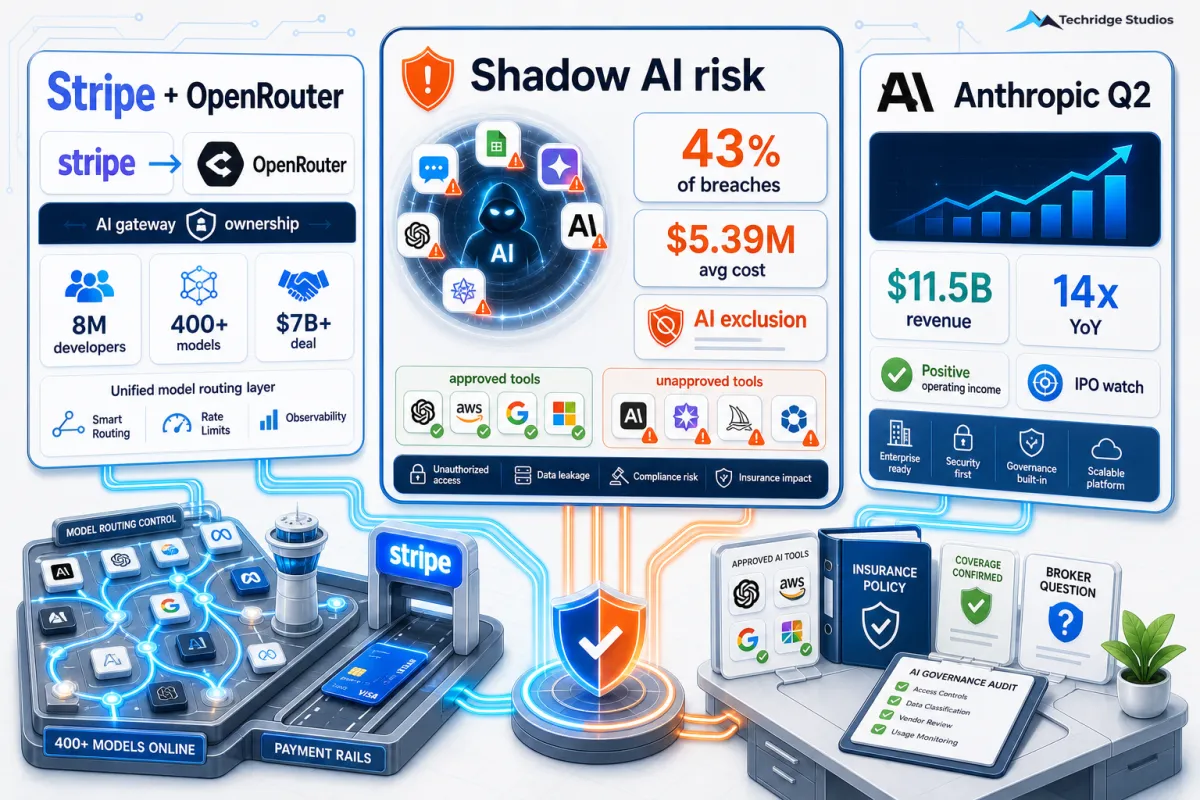
Stripe has finalized a deal to acquire OpenRouter for more than $ 7 billion, according to Bloomberg and TechCrunch. The 7 billion price tag represents a 5x markup on the 1.3 billion valuation OpenRouter secured in a Series B round just three months ago, in May 2026.
OpenRouter is the AI model routing gateway used by roughly 8 million developers to access over 400 AI models — from OpenAI and Anthropic to Google, Meta, and DeepSeek. The startup routes traffic to the best model for each task based on cost, speed, and capability. In the past year, it processed approximately 1.5 quadrillion tokens. Its annual revenue run rate grew from $ 19 million in early 2025 to $ 50 million by March 2026.
What makes this significant for small businesses is that OpenRouter was, before this deal, the neutral layer. It had no reason to favor one model provider over another, making it a trusted tool for developers seeking to keep AI costs low and flexible. Stripe, by contrast, is a payments company whose business model is built on transaction volume. The concern is not necessarily that Stripe will do something harmful — it is that the business incentives have changed.
If your business uses any AI tool that routes across multiple models under the hood — which many do, even if you never see it — this acquisition is worth tracking. Pricing terms have not been announced. When they are, smaller teams will feel the impact first. Watch for announcements in the next 30 to 60 days.
Shadow AI Is Now an Insurance Problem, Not Just an IT Problem
IBM's 2026 Cost of a Data Breach Report, covered today by Forbes, found that shadow AI — the AI tools employees adopt without company approval — appeared in 43 percent of security breaches last year. That is nearly double the share from the prior year. And 68 percent of organizations that experienced a breach had no AI governance policy.
The financial impact is already clear. Breaches involving shadow AI averaged $ 5.39 million per incident, compared to a global average of just under $ 5 million. The extra cost comes from delayed detection, broader data exposure, and the lack of containment protocols that proper tool vetting provides.
But the insurance angle is what makes this story different in 2026. ISO, the Verisk-owned bureau that writes standard policy language for American insurers, is circulating a generative AI exclusion clause — form CG 40 47 01 26, with a January 2026 edition date — for commercial general liability coverage. That means standard business insurance policies are now being written to exclude AI-related incidents.
If an employee downloads an AI writing tool, a data processing tool, or a chatbot integration that has not been vetted by your organization, and that tool contributes to a breach, your insurer may be able to deny the claim under this exclusion. For small businesses without dedicated IT or legal teams, this risk is invisible until it is too late.
The fix is straightforward even if it takes a few hours to implement. Create a short written list of approved AI tools. Send it to your team with a note asking them to check before adopting anything new. Then contact your insurance broker directly and ask: Does my current policy cover AI-related security incidents? Ask them specifically whether any AI exclusions have been added to your policy in the last twelve months. Do not wait until you need to file a claim.
UPDATE: Anthropic's Record Quarter and What It Signals for Businesses on Claude
Anthropic posted more than 11.5 billion dollars in preliminary Q2 2026 revenue, according to reporting from CNBC and The Information. That is a 14-fold jump from the same quarter a year ago, when Anthropic posted 787 million dollars. It also more than doubles Q1 2026's 4.73 billion figure. The company also reported positive adjusted operating income for the quarter.
These numbers matter for small businesses in two ways. First, if you are already using Claude — through the API, Anthropic's tools, or any product built on the Claude platform — you are on a platform that is now clearly the strongest-performing paid AI business in the market. That stability reduces the risk of building workflows and systems on Claude, a legitimate concern for businesses evaluating long-term AI commitments.
Second, an IPO is reportedly being planned for this fall, which would make Anthropic one of the first major private AI companies to list publicly. Public companies are subject to additional financial accountability and transparency requirements. For business customers, that generally means more stable contracts, more predictable pricing disclosures, and stronger data governance assurances than a private company is required to provide.
For businesses still deciding which AI platform to standardize on, Anthropic's Q2 numbers make Claude harder to ignore. The gap between Anthropic and its nearest revenue competitors is widening. That is rarely a reason on its own to make a platform decision — but it is a signal worth factoring in.
What This Means for Your Business
Today's three stories point to the same reality: AI is no longer in the evaluation phase. It is infrastructure. And like any infrastructure, it comes with ownership structures, liability exposure, and platform commitments that your business needs to actively manage.
If you use AI tools, know who owns the routing layer. Know which tools your team is using without approval. And know which platform you are committing to for the long term. Those are not IT questions — they are business decisions.
One clear action you can take today: send your team a two-sentence note listing the approved AI tools and asking them to check with you before using anything new. That single step reduces your insurance exposure, gives you visibility into your AI stack, and puts you ahead of 68 percent of the businesses that have already experienced a breach.
Sources
TechCrunch — https://techcrunch.com/2026/08/16/stripe-will-reportedly-acquire-ai-gateway-startup-openrouter-for-7b/
Forbes / IBM 2026 Cost of a Data Breach Report — https://www.forbes.com/sites/guneyyildiz/2026/08/17/companies-cannot-price-the-shadow-ai-risk-they-cannot-see/
CNBC — https://www.cnbc.com/2026/08/15/anthropic-revenue-jumps-to-over-11point5-billion-in-q2-report.html