Workforce Shift, Billing Shock, and the AI ROI Reality Check
Three significant AI developments landed this week — one reshaping how America thinks about jobs, one upending how businesses pay for developer tools, and one giving every business owner permission to stop pretending their AI results are what they expected.
Big Tech Just Bet $500 Million on Reskilling American Workers
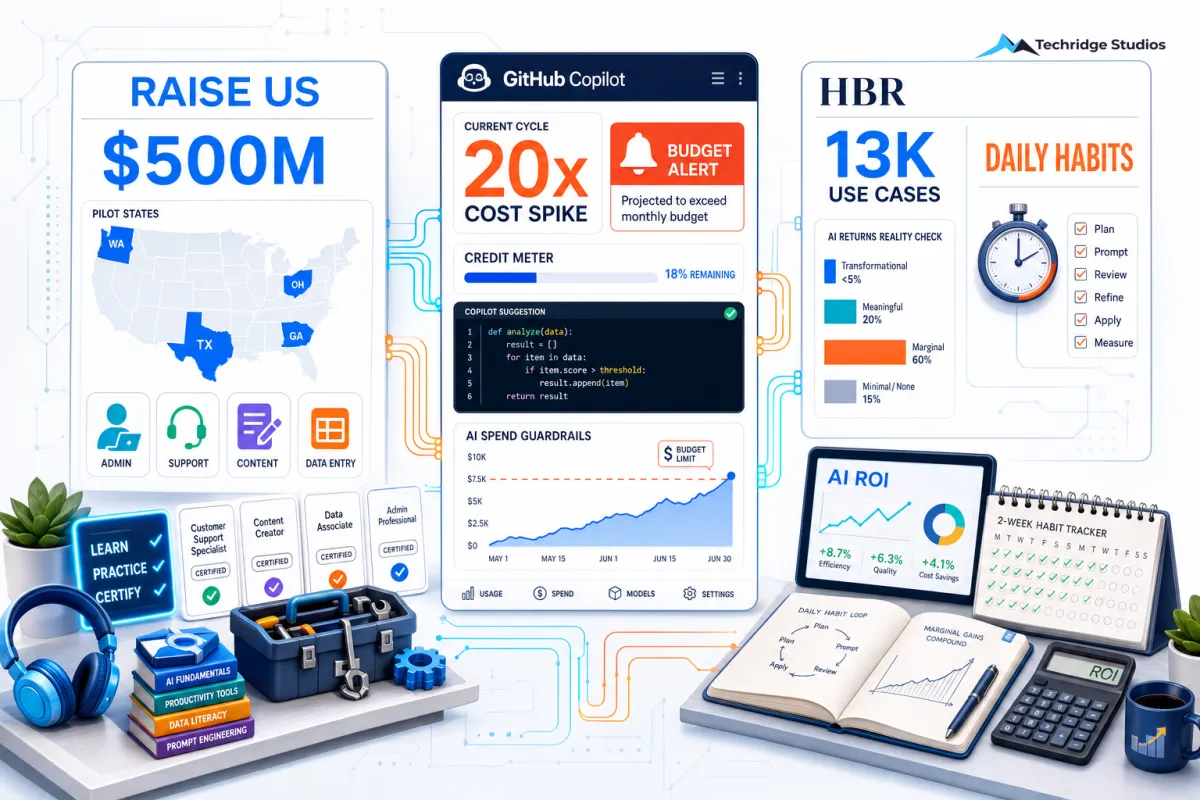
On June 25, 2026, former US Commerce Secretary Gina Raimondo and former Indiana Governor Eric Holcomb launched RAISE US — a nonpartisan national nonprofit with an ambitious goal: to raise $1 billion to help American workers transition into an AI-shaped economy. They already have $500 million secured, with Amazon, Anthropic, Microsoft, and the OpenAI Foundation as anchor partners. Bipartisan governors in Arkansas, Connecticut, Maryland, and Utah have signed on for the first round of state pilot programs.
The initiative arrives as workforce data turns increasingly stark. Anthropic's June 2026 Economic Index found that over 35 percent of workers expect AI to handle most or nearly all of their work tasks within the next 12 months. A study cited by Metaintro found that AI accounted for 88,000 US job cuts in 2026 — more than all prior years combined. The International Monetary Fund has specifically flagged entry-level knowledge workers as the most exposed category.
For small business owners, this is not an abstract macro trend. The roles most at risk — administrative support, customer-facing positions, content creation, data entry — are precisely the roles that keep small businesses running. Enterprise companies can absorb displaced workers through retraining departments and internal mobility programs. Most SMBs cannot.
What to do now: Start with an honest inventory. Which tasks on your team could AI already do at an acceptable quality level? Which people on your team are building toward work that AI cannot easily replicate? You do not need a workforce strategy department. You need one honest conversation with each team member about where their role is heading and how you plan to support them through it.
GitHub Copilot's First Metered Bill Just Arrived — and Developers Are Shocked
June 30, 2026, is not just the end of the month. It is the close of GitHub Copilot's first full metered billing cycle since the platform moved to usage-based pricing on June 1, 2026. The reaction across Reddit, X, and GitHub's own community forums has been immediate and loud.
Developers who previously paid $29 per month for Copilot Pro are seeing projected bills of $750 or more. Developers on heavier agentic workflows — running Copilot's multi-step autonomous code editing, PR review automation, and codebase-wide refactoring — are seeing bills in the thousands. GitHub Chief Product Officer Mario Rodriguez did not soften the message: "Copilot is not the same product it was a year ago."
The mechanics: 1 GitHub AI Credit costs $0.01 and is consumed at the published API rate per model. Code completions and Next Edit suggestions remain free. The meter runs on agentic sessions, premium frontier model access, multi-step autonomous tasks, and automated code review. Previously, exhausting credits fell back to a cheaper model — work continued. Now, hitting zero stops premium features until credits are purchased or the cycle resets.
Competitors are already moving. Claude Code from Anthropic operates under a flat-rate Pro subscription with no token metering. Cursor has maintained a more predictable pricing model. Both are actively recruiting developers frustrated with Copilot's billing change.
What this means for your business: If your team includes developers using Copilot, check your GitHub billing dashboard today. Assess which workflows are driving the highest usage and whether the cost is justified by the output. More broadly, this is not a GitHub-specific story. The same economics are playing out across every major AI platform. The flat-rate AI subscription is ending. Treat your AI spend the way you treat cloud costs — with usage monitoring, budget alerts, and regular reviews.
HBR Just Gave You Permission to Admit AI Has Been Underwhelming
Harvard Business Review's 2026 "AI in the Wild" study analyzed nearly 13,000 real generative AI use cases, sourced from real-world posts and conversations on Reddit, LinkedIn, TikTok, and YouTube. The headline finding is worth sitting with: most AI activity in organizations produces marginal benefits, not paradigm shifts. Businesses are using AI to speed up existing processes — summarizing meeting notes faster, generating first drafts, and cleaning up data for presentations. The transformation they expected is not happening.
The number-one use case globally by volume was therapy and emotional support — accounting for 11 percent of all AI interactions, up from 5 percent the year before. Technical troubleshooting was second. "Fun and nonsense" — playful, unproductive interactions with no declared business purpose — was third. Strategic planning and revenue-generating applications were not in the top three.
The study also flagged a structural issue: shadow AI usage is spreading. Employees are using AI tools without telling their managers because company policies are unclear, too restrictive, or nonexistent. This creates a governance gap — not just a security risk, but a missed opportunity. When AI use is hidden, businesses cannot learn from it or improve it.
The study does not just diagnose the problem — it identifies what separates high-performing AI users from average ones. Top performers share one habit: they build consistent, daily routines around specific, high-frequency tasks. They do not try to transform the business with AI in week one. They pick one thing they do every single day, apply AI to it consistently, and compound the efficiency over time.
What to do now: Pick one task you or your team does every weekday — a morning standup summary, a customer response, a weekly report, a social post. Run AI on that single task every day for two weeks. At the end of two weeks, measure how much time you saved. That measurement is your ROI baseline. Build from there.
What This Means for Your Business
Three separate stories were published this week, and they all point in the same direction: the AI ramp-up is real, the costs are arriving, and the returns require intention to materialize.
RAISE US says the workforce shift is moving fast enough that the people who built the technology are funding retraining. GitHub Copilot tells you the era of all-you-can-eat AI for a flat monthly fee is ending. The HBR study tells you that most businesses — including yours — are not yet seeing transformation from AI, and that the path to achieving it is specific, consistent, and low-drama.
The single next action: audit your AI tools, your team's exposure to automation, and your current usage patterns. Then pick one task to systematize. Start there.
Sources
Rockefeller Foundation — https://www.rockefellerfoundation.org/news/raise-us-launches-uniting-nations-leading-employers-and-bipartisan-governors-behind-american-workers/
GitHub Blog — https://github.blog/news-insights/company-news/github-copilot-is-moving-to-usage-based-billing/
Harvard Business Review — https://hbr.org/2026/06/how-people-are-really-using-ai-in-2026