YouTube Labels Your AI Videos Now — Ready or Not
Three stories from this week share a common thread: the AI decisions businesses made in the past year are starting to have consequences. Platforms are enforcing disclosure. Regulators are setting deadlines. And the gap between how many small businesses use AI and how many are ready for what comes next is one of the more important business risks heading into the second half of 2026.
YouTube Will Label Your AI Content — With or Without You
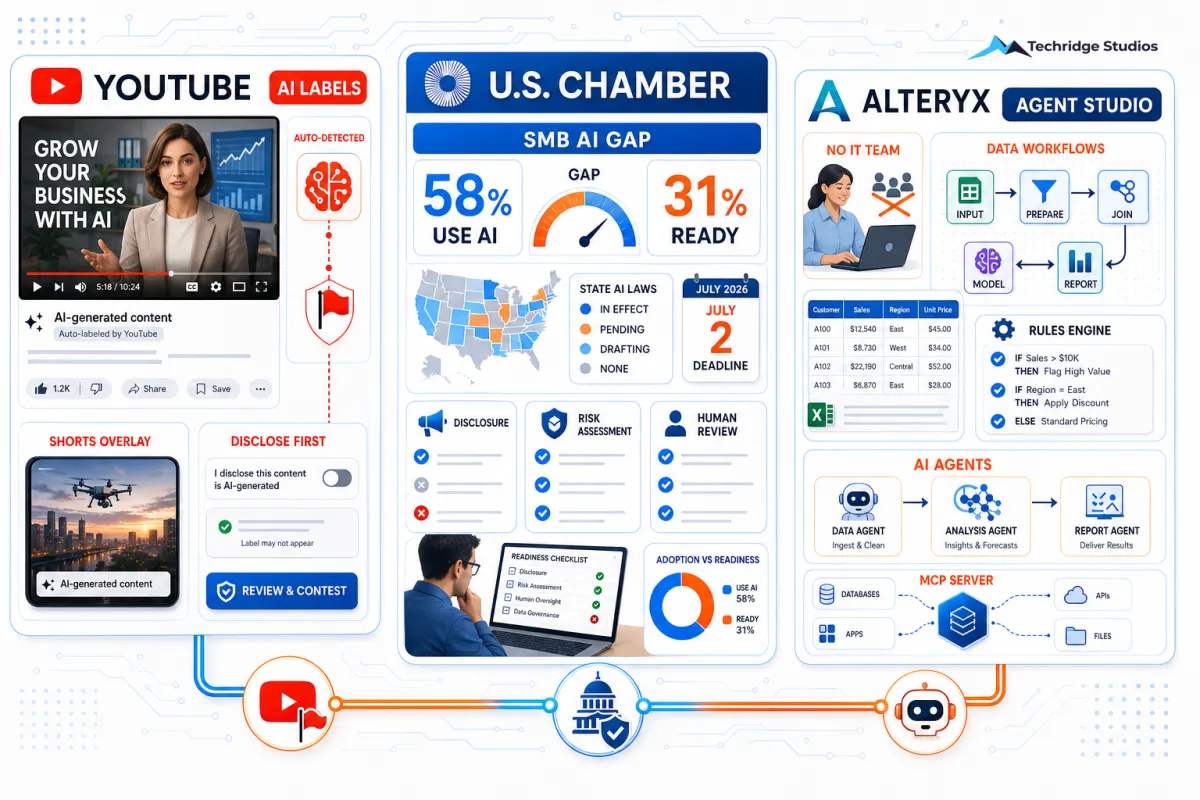
YouTube announced this week that it will begin automatically detecting and labeling videos that contain substantial photorealistic AI-generated content. The change matters because it removes creator control from the disclosure timeline. Previously, creators chose whether and when to disclose AI use. Now YouTube's internal detection systems make that call, and if they flag your content, the label appears — whether you put it there or not.
For creators and small businesses using AI in marketing video, the practical implication is clear: get ahead of this. Review any video content you've published that uses AI-generated imagery, voiceover, or footage. Apply the disclosure label yourself before YouTube does it for you. A self-applied label reads as transparency; an auto-applied label can read as evasion — even when it wasn't intentional.
YouTube is also repositioning the label on published videos. On long-form content, it now appears below the video player above the description. On Shorts, it appears as a video overlay. Both positions are significantly more visible than before. Creators who believe their content was incorrectly flagged can contest labels through YouTube Studio.
The broader signal: major platforms are moving toward mandatory disclosure infrastructure. YouTube today, other platforms soon. Building disclosure habits now is simpler than retrofitting them under pressure.
The U.S. Chamber Report: Adoption Is Outrunning Readiness
The U.S. Chamber of Commerce released the fourth edition of its "Empowering Small Business" report this month, the first to include a full 50-state breakdown of technology and AI adoption. The headline finding is genuinely encouraging: 58 percent of small businesses now use generative AI, up from 40 percent in 2024 and more than double the adoption rate in 2023.
But the same report contains the more important number: only 31 percent of small business owners feel well-prepared to comply with proposed AI laws that would require disclosure of AI use, risk assessments, and human oversight of consequential decisions.
That gap — 58 percent using AI, 31 percent ready for what comes with it — is the defining small business AI story of 2026. AI adoption has moved fast. Regulatory infrastructure is now catching up, and it is not catching up slowly. California's AI disclosure bills head to a vote July 2nd. If they pass, businesses using AI in hiring, pricing, and customer-facing decisions will need documented disclosure practices and human review processes in place by the fall.
The readiness gap is closeable. A basic audit of where your business uses AI, a brief customer-facing disclosure statement, and a documented process for human review of high-stakes AI decisions will put you ahead of most competitors. This is not a legal team exercise — it is a business operations exercise.
Alteryx Agent Studio: AI Agents Without the IT Dependency
Alteryx used its Inspire 2026 conference in Orlando this month to announce Agent Studio, a new capability within its Alteryx One platform. The tool does something genuinely useful for data-driven businesses: it lets business analysts convert existing data workflows — rules, analysis, decisions — directly into autonomous AI agents, without involving IT or software developers.
The context matters. Most small businesses that work with data have at least some structured workflows: spreadsheet models they run every week, reports they pull on schedule, approval logic that follows predictable rules. Agent Studio is designed to take exactly those kinds of existing, tested workflows and promote them to autonomous agents that can run, monitor, and trigger on their own.
The platform also launched an MCP Server, which allows agents built in Alteryx to connect with external AI orchestration frameworks. For businesses already using AI tools from other vendors, this creates a path to connecting those tools without custom development.
The core SMB implication: you do not need to build AI agents from scratch or hire a developer to get there. If you already have data and a team member who understands how your business works, Agent Studio is designed for them. The barrier to building and deploying custom automation just dropped.
What This Means for Your Business
This week's stories point to one practical action: close the gap between using AI and being ready for the consequences. Most small businesses are on the right side of adoption. Fewer are on the right side of accountability.
Start with a simple audit: where in your business does AI touch a customer, an employee decision, or a public-facing output? List those touchpoints. Add a disclosure where it's visible. Document who reviews AI-assisted decisions for accuracy. That is the readiness floor — and most of your competitors haven't built it yet.
Sources
TechCrunch — https://techcrunch.com/2026/05/27/youtube-will-now-automatically-label-ai-videos/
U.S. Chamber of Commerce — https://www.uschamber.com/technology/artificial-intelligence/u-s-chambers-latest-empowering-small-business-report-shows-majority-of-businesses-in-all-50-states-are-embracing-ai